
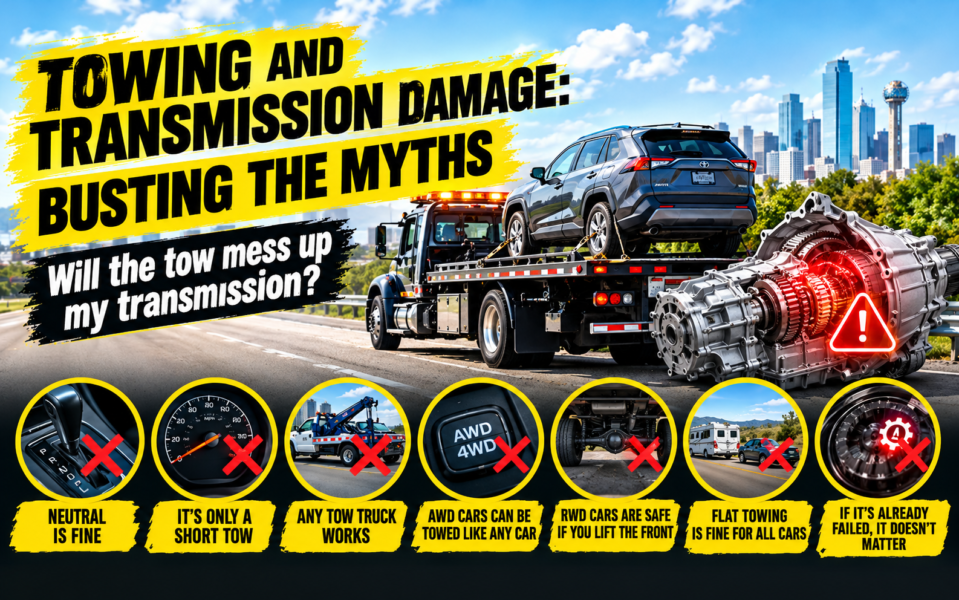
“Will the tow mess up my transmission?”
It’s one of the most common questions our drivers hear, usually from someone who’s already having a rough day. And it’s a fair question. A transmission repair can cost thousands of dollars, so nobody wants to trade one problem for a bigger one.
The honest answer: towing doesn’t damage transmissions. Towing the wrong way does. The trouble is that there’s a lot of bad advice out there. Let’s clear up the biggest myths we hear on the road across Dallas-Fort Worth.
Towing can damage a transmission if the drive wheels stay on the ground while the engine is off, because the transmission spins without proper lubrication. Front-wheel-drive cars are usually safe to tow with the front wheels lifted. Rear-wheel-drive cars need the rear wheels lifted or the driveshaft disconnected. AWD and 4WD vehicles are safest on a flatbed with all four wheels off the road.
Why Towing Can Hurt a Transmission at All
Here’s the simple version. In most automatic transmissions, the fluid pump only works when the engine is running. If your car is towed with its drive wheels rolling on the road, those wheels turn parts inside the transmission.
With the engine off, the pump isn’t sending fluid where it’s needed. So the internal parts spin with little lubrication. Over enough distance, that creates heat and wear, and that’s where damage starts.
Now, on to the myths.
Myth 1: “Just Put It in Neutral and It’s Fine”
This is the big one, and it’s wrong for most automatic cars.
Neutral disconnects the engine from the transmission, but it does not stop the wheels from turning the transmission’s output side. With the engine off, there’s still no fluid pump running. So the parts spin without the lubrication they need.
Neutral is helpful for moving a car a few feet onto a truck. It is not a free pass to drag an automatic for miles on its drive wheels.
Myth 2: “It’s Only a Short Tow, So It Doesn’t Matter”
Short distances reduce the risk, but they don’t remove it. Some manufacturers allow limited towing with the drive wheels down at low speeds. Others don’t allow it at all.
The only reliable source is your owner’s manual. Look for a section on towing or “recreational towing.” If the manual says don’t tow with the drive wheels on the ground, that applies to a two-mile trip just as much as a 50-mile trip.
Myth 3: “Any Tow Truck Works for Any Car”
Not every tow is the same. There are three common methods:
| Tow method | How it works | Best for |
| Wheel-lift | Lifts one end of the car; the other two wheels roll | Many front-wheel-drive cars (front lifted) |
| Flatbed | The whole car sits on a bed, no wheels on the road | AWD, 4WD, luxury, low cars, EVs, damaged cars |
| Dolly or driveshaft disconnect | Extra wheels or a disconnected driveshaft keep drive wheels from turning the transmission | Rear-wheel-drive cars when a flatbed isn’t used |
A good tow operator asks about your vehicle before choosing the method. If nobody asks whether your car is AWD, that’s a red flag.
Myth 4: “AWD Cars Can Be Towed Like Any Other Car”
This myth causes some of the most expensive damage we see.
All-wheel-drive and four-wheel-drive vehicles send power to all four wheels. Lift just the front or just the back, and the wheels still on the road turn parts of the drivetrain. That can damage the transfer case, center differential or transmission.
For most AWD and 4WD vehicles, a flatbed is the safest choice. If you drive a Subaru, an AWD SUV or a 4×4 truck, tell the dispatcher when you call. Our emergency towing team will send the right truck for the job.
Myth 5: “Rear-Wheel-Drive Cars Are Safe If You Lift the Front”
It’s actually the opposite. On a rear-wheel-drive car, the rear wheels are the drive wheels. Lifting the front leaves the rear wheels rolling on the road, which turns the transmission.
The safer options are to lift the rear wheels, use a dolly under them, disconnect the driveshaft, or use a flatbed. Trucks, many sports cars and some luxury sedans are rear-wheel drive, so it’s worth knowing which one you have.
Myth 6: “Flat Towing Behind an RV Is Fine for Every Car”
Flat towing, sometimes called dinghy towing, means pulling a car behind a motorhome with all four wheels on the road. Some vehicles are designed for it. Many are not.
Manufacturers that allow it usually list specific steps, like a certain gear position, a fuse to pull or a maximum speed. Skip those steps, or flat tow a car that isn’t approved for it, and you could be looking at a ruined transmission. If you’re traveling with an RV, our RV towing service team can help with breakdowns along the way.
Myth 7: “If the Transmission Already Failed, the Tow Method Doesn’t Matter”
It still matters. A transmission that’s slipping or locked up can get worse if it’s dragged. Fixing a damaged transmission is expensive. Replacing one that was destroyed during a bad tow costs even more.
If your car shows transmission warning signs, like slipping gears, grinding, a burning smell or refusing to go into drive, stop driving and ask for a flatbed. It protects the parts that might still be saved.
How to Protect Your Transmission When You Need a Tow
- Know your drivetrain. Check your owner’s manual or the badge on the back of your car for FWD, RWD, AWD or 4WD.
- Tell the dispatcher. Mention your drivetrain and what’s wrong with the car.
- Ask how it will be towed. You’re allowed to ask, and a good company will explain.
- Request a flatbed when in doubt. It’s the safest option for nearly every vehicle.
- Choose an experienced company. Trained operators know the difference and won’t take shortcuts.
Need to move a car farther than a local tow? Our long distance towing service is built for longer trips without extra wear on your drivetrain.
Towing Done Right Across DFW
At Alpha Tow Truck Services, we match the tow method to your vehicle before a truck leaves the yard. That’s part of how we’ve served DFW drivers for over 20 years.
We offer 24 hour towing across Dallas, Plano, Garland, Irving, Mesquite and the rest of the Metroplex. Call (214) 225-6493 for a flat price before dispatch.
Frequently Asked Questions
Can towing damage an automatic transmission?
Yes, if the car is towed with its drive wheels on the road and the engine off. The transmission spins without proper lubrication, which can cause heat and wear.
Is it safe to tow a car in neutral?
For most automatic cars, neutral alone doesn’t protect the transmission over long distances. Check your owner’s manual or use a flatbed.
How should an AWD car be towed?
Most AWD and 4WD vehicles should be towed on a flatbed with all four wheels off the ground.
Can a front-wheel-drive car be towed with a wheel-lift?
Usually yes, as long as the front wheels are lifted and the rear wheels roll freely.
Should electric vehicles be towed on a flatbed?
Most EV makers recommend flatbed towing. Check your owner’s manual and mention it’s an EV when you call.