
The first cold morning of the season always brings the same scene across Dallas-Fort Worth. You’re running late, you turn the key and nothing. Maybe a click. Maybe a slow, tired crank. Maybe the dash lights up but the engine won’t turn over.
Cold weather doesn’t usually cause car trouble on its own. It exposes problems that were already there, especially a weak battery. Here’s how to figure out what’s wrong and whether a jump start will get you going or you need a tow.
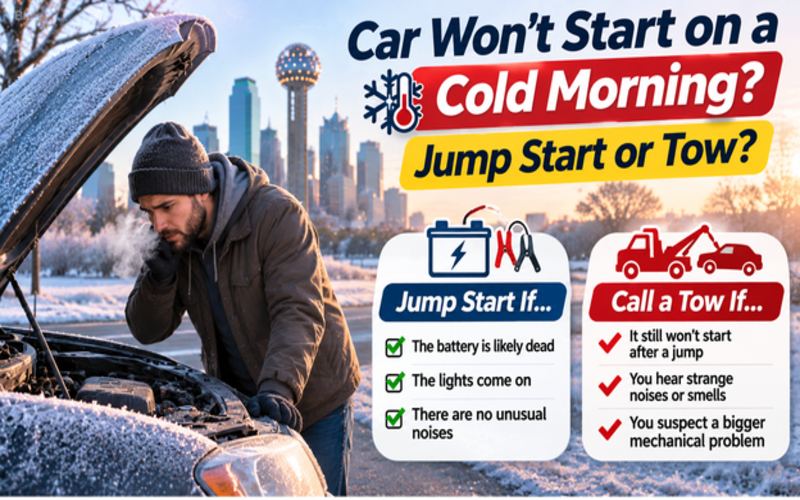
The most common reason a car won’t start on a cold morning is a weak or dead battery. Other causes include corroded battery cables, a failing starter, a bad alternator, thick oil and fuel problems. If you hear clicking or slow cranking, a jump start often works. If the car cranks normally but won’t start, or dies again right after a jump, it usually needs a tow to a shop.
Why Cold Weather Kills Car Batteries
A car battery makes power through a chemical reaction, and cold slows that reaction down. At the same time, cold engine oil is thicker, so the engine is harder to turn over. That’s a double hit: the battery has less power just when the engine needs more.
Texas adds another twist. Hot summers wear batteries down faster, so by November, many batteries are already weak. The first cold snap is often what finally finishes them off.
What the Sound Tells You
| What you hear or see | Most likely cause | Jump start or tow? |
|---|---|---|
| Nothing at all, no dash lights | Dead battery or loose cable | Try a jump; check cables |
| Rapid clicking | Weak battery | Jump usually works |
| Single loud click | Starter or bad connection | Jump may not help; possible tow |
| Slow, labored crank | Weak battery or thick oil | Jump usually works |
| Normal crank, won’t start | Fuel, ignition or sensor problem | Usually a tow |
| Starts, then dies right away | Fuel or air problem, or alternator | Usually a tow |
The 6 Most Common Causes
1. A Weak or Dead Battery
Most car batteries last a few years, and Texas heat can shorten that. If your battery is getting old, cold weather is often the moment it fails.
Signs: slow cranking, dim lights, clicking, or a battery warning light.
2. Corroded or Loose Battery Cables
White or green crust on the battery terminals blocks the flow of power. Loose cables do the same.
Signs: the car works sometimes and not others, or the battery tests fine but the car still won’t start.
3. A Failing Starter
The starter turns the engine over. When it starts to fail, you may hear a single click, grinding or nothing at all, even with a good battery.
4. A Bad Alternator
The alternator recharges the battery while you drive. If it’s failing, the battery slowly drains, and the cold morning is when it finally shows.
Signs: the car starts after a jump but dies again soon, or the battery light comes on while driving.
5. Thick Oil
Cold makes oil thicker, which makes the engine harder to turn. Using the oil weight in your owner’s manual helps.
6. Fuel Problems
A failing fuel pump or very low fuel can keep the car from starting. You may hear the engine crank normally but never catch.
How to Jump Start Safely
If you’re going to jump the car yourself:
- Park the working car close, but don’t let the cars touch.
- Turn both cars off.
- Connect red to the dead battery’s positive (+) terminal.
- Connect red to the good battery’s positive (+) terminal.
- Connect black to the good battery’s negative (−) terminal.
- Connect the last black clamp to bare metal on the dead car, away from the battery.
- Start the working car, wait a few minutes, then try the dead car.
- Remove cables in reverse order.
Check your owner’s manual first. Some newer cars have special jump points or warnings.
If you’d rather not do it yourself, or you’re on a busy roadside, our battery jump start service comes to you.
When a Jump Isn’t Enough
Call for a tow if:
- The car cranks normally but won’t start
- It starts, then dies again quickly
- You hear grinding or a single click with a good battery
- The battery is cracked, leaking or swollen
- Warning lights stay on after the car starts
Our emergency tow team can take your car to your mechanic or a battery shop.
How to Prevent Cold-Start Problems
- Test your battery before winter. Many auto parts stores do it for free.
- Clean the terminals if you see corrosion.
- Park in a garage on cold nights if you can.
- Don’t leave lights or chargers on overnight.
- Drive longer trips sometimes. Short trips don’t fully recharge the battery.
24/7 Jump Starts and Towing Across DFW
Alpha Tow Truck Services offers jump starts, flat tire changes, fuel delivery, lockout help and towing across Dallas, Plano, Garland, Rowlett, Irving, Mesquite, McKinney and Richardson.
Call (214) 225-6493 or request dispatch.
Frequently Asked Questions
Why won’t my car start when it’s cold?
Usually a weak battery. Cold reduces battery power while making the engine harder to turn over.
My car clicks but won’t start. What does that mean?
Rapid clicking usually means a weak battery. A single click may mean a starter or connection problem.
Will a jump start fix my car?
If the battery is the problem, often yes. If the car cranks normally but won’t start, it likely needs a shop.
Why did my car die again after a jump?
The alternator may not be charging the battery, or the battery can’t hold a charge anymore.
How do I know if I need a new battery?
Slow starts, dim lights and repeated jumps are signs. A battery test will confirm it.