
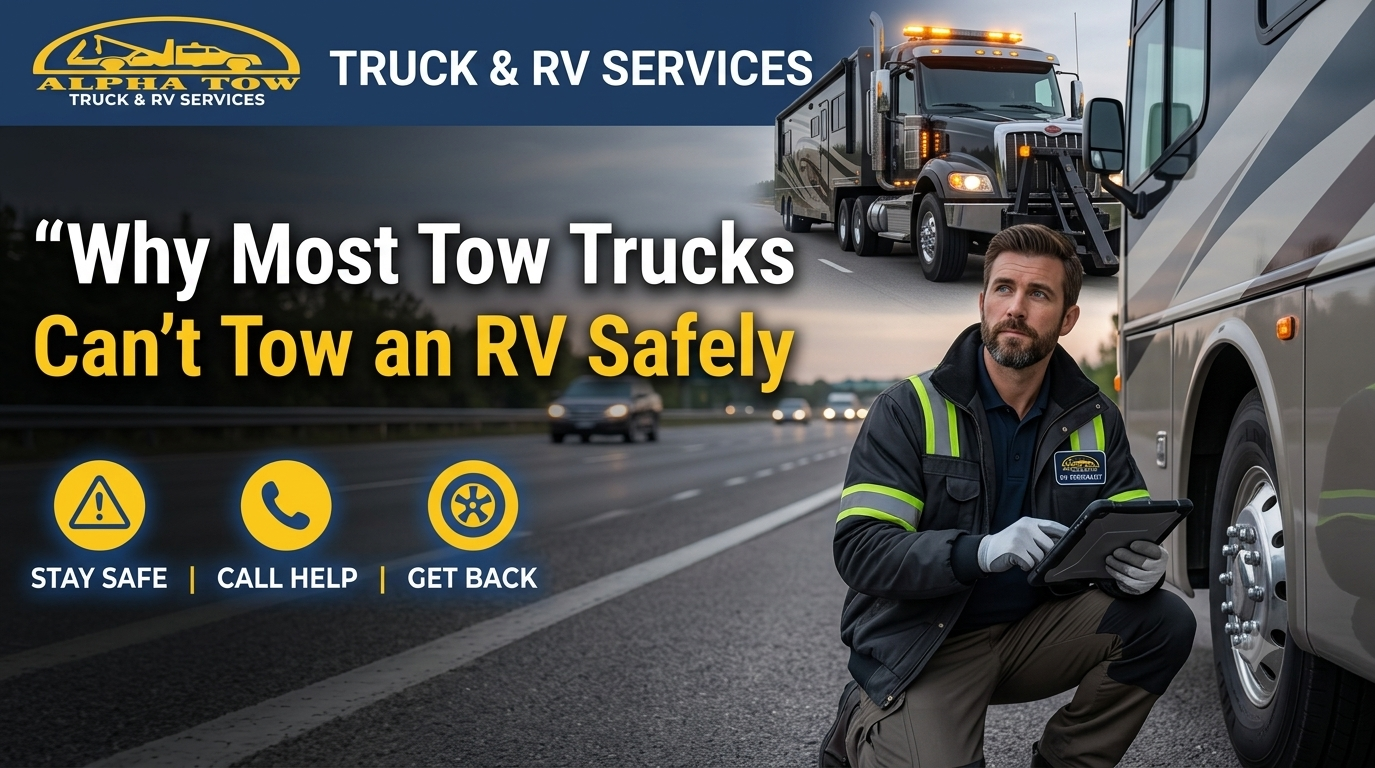
When an RV breaks down, many owners assume any nearby tow truck can move it. After all, if a tow truck can handle a car or pickup, shouldn’t it be able to tow a motorhome or camper?
Not necessarily.
RVs are larger, heavier, longer, and often configured very differently from passenger vehicles. A motorhome may have a large body extending well beyond its chassis, while a travel trailer can have its own axle configuration, hitch requirements, and weight distribution.
Most standard tow trucks are designed for lighter vehicles. RV towing may require equipment rated for the RV’s size and weight, along with the correct connection and loading method. Using the wrong equipment can increase the risk of vehicle, trailer, or equipment damage.
That’s why choosing the right RV towing service starts with identifying exactly what type of recreational vehicle you have and what happened to it.
Why Can’t a Regular Tow Truck Tow Every RV?
The biggest issue is not simply whether the tow truck can physically move the RV.
The question is whether the truck and towing equipment are rated and configured for the load.
A small tow truck designed for a sedan may not have the capacity, frame strength, wheel-lift configuration, or recovery equipment needed for a large motorhome.
Alpha Tow Truck Services specifically states that RVs require specialized towing because of their size, weight, and configuration, and its RV service uses carriers designed for larger recreational vehicles.
Several factors make RV towing different.
1. RVs Can Be Much Heavier Than Passenger Vehicles
A typical passenger car is relatively straightforward to tow compared with a large motorhome or loaded RV trailer.
An RV may contain:
- Furniture
- Appliances
- Water tanks
- Batteries
- Generator equipment
- Camping gear
- Personal belongings
- Additional exterior equipment
That additional weight matters.
A towing company needs to know the approximate size and weight of the RV before dispatching equipment. Sending an undersized tow truck can create problems even if the vehicle appears to be sitting in an easy location.
2. The RV’s Size Changes How It Must Be Handled
An RV is not simply a bigger car.
Motorhomes can be significantly taller and wider than ordinary vehicles. Travel trailers can also have long wheelbases and different weight distributions.
The towing operator needs to consider clearance, loading angles, turning space, axle position, and the condition of the vehicle.
A tow setup that works perfectly for a sedan may not be appropriate for a large recreational vehicle.
3. Motorhomes and Trailers Are Not the Same
The term “RV” covers several different vehicle types.
A motorhome is self-powered. A travel trailer or camper trailer normally depends on another vehicle for towing.
That distinction matters when arranging motorhome towing or camper towing.
For example, a disabled motorhome may need to be transported as a single powered vehicle, while a travel trailer that has lost its tow vehicle presents a different towing situation.
Alpha’s RV service specifically covers motorhomes, campers, travel trailers, and RV trailers, including trailers that have lost their tow vehicle.
4. A Broken-Down RV May Need More Than Transportation
Consider an RV that has a mechanical failure on a highway.
If the vehicle is still safely positioned and can be loaded, the job may be relatively straightforward.
But what if it is:
- Stuck in soft ground
- Partially off the roadway
- In a campground with limited access
- Damaged after an accident
- Unable to roll normally
- Blocking traffic
- Connected to a trailer
- Located in a confined parking area
The situation may require additional recovery equipment or a different towing approach.
This is why telling the dispatcher what happened, not just saying “I need an RV tow,” is important.
What Makes an RV Towing Service Different?
A proper RV towing service should start by matching the equipment to the recreational vehicle.
Before dispatch, useful information includes:
| Information | Why It Matters |
|---|---|
| RV type | Determines the basic towing approach |
| Make and model | Helps identify size and configuration |
| Approximate weight | Helps determine equipment requirements |
| Motorhome or trailer | Changes how the vehicle is handled |
| Current location | Determines access and roadside conditions |
| Breakdown or accident | Indicates whether recovery may be required |
| Whether wheels can roll | Helps determine loading/transport method |
| Destination | Helps plan the transport |
Alpha’s RV dispatch process asks customers to provide the vehicle type and location so the appropriate equipment can be matched to the call.
Why Searching “RV Towing Near Me” Isn’t Enough
When an RV owner searches for RV towing near me, proximity is obviously important.
But the closest tow truck isn’t automatically the right tow truck.
Imagine you find a tow company five minutes away, but the available unit is designed for standard cars. Another provider may be farther away but have an RV-rated carrier capable of handling your motorhome.
For an RV, equipment suitability should be part of the decision, not just distance.
Before accepting a dispatch, ask:
“Do you have equipment rated for my RV?”
You can also provide the RV’s type, approximate size, weight, and current condition.
That gives the dispatcher a better chance of sending the right unit the first time.
Why Motorhome Towing Requires Special Consideration
Motorhomes combine the characteristics of a vehicle and a large recreational structure.
Their height can create clearance concerns. Their weight affects the towing equipment required. Their body construction and chassis configuration can also affect how they should be loaded or secured.
If a motorhome has been involved in an accident, the situation becomes even more complicated.
A damaged wheel, steering component, suspension system, or body section can change how the vehicle needs to be moved.
That is why motorhome towing should be treated differently from ordinary passenger-vehicle towing.
What About Camper Towing?
Camper towing can also vary significantly depending on the trailer.
A small camper may have completely different towing requirements from a large travel trailer.
The operator may need to know:
- Trailer size
- Approximate loaded weight
- Number of axles
- Whether the trailer is still connected to the tow vehicle
- Whether the wheels and tires are functional
- Whether the trailer is damaged
- Where the trailer needs to go
If the trailer has become separated from its tow vehicle, the towing company may need to handle the trailer independently.
Alpha specifically offers RV trailer towing for situations where a trailer has lost its tow vehicle.
What Can Go Wrong With the Wrong Tow Equipment?
Using unsuitable equipment can create several problems.
Vehicle damage
Incorrect lifting or securing can potentially damage wheels, suspension components, body panels, or other parts.
Equipment limitations
A tow truck that is not rated for the load may not be appropriate for the job.
Difficult loading
An RV that cannot be loaded normally may require additional equipment or a different carrier.
Road clearance problems
Large RVs have greater height and width considerations than standard vehicles.
Delays
If the first tow truck arrives and cannot safely handle the RV, another unit may have to be dispatched.
This is one reason it is better to provide accurate vehicle information before the truck is sent.
When Should You Call an RV Towing Service?
You may need RV towing when the vehicle cannot safely continue to its destination.
Common situations include:
- Engine or mechanical breakdown
- Flat or damaged tires
- Accident damage
- Transmission problems
- Electrical failure
- Overheating
- Trailer separation
- Vehicle stuck in an unsafe location
- Mechanical failure at a campground
- An RV that needs transportation to a repair facility
Not every situation requires a tow. Sometimes roadside assistance can solve a problem without transporting the RV.
However, if the RV cannot safely continue, towing may be the appropriate next step.
RV Towing vs. Roadside Assistance
These services can overlap, but they are not identical.
| Situation | Roadside Assistance | RV Towing |
|---|---|---|
| Dead battery | Often appropriate | Usually unnecessary |
| Flat tire | Often appropriate | May not be needed |
| Minor roadside issue | Often appropriate | Depends |
| Major mechanical failure | May assess/assist | Often appropriate |
| Vehicle cannot move | Limited | Appropriate |
| Accident damage | May assist | May be required |
| RV needs transport | No | Yes |
| Trailer loses tow vehicle | No | Specialized RV trailer towing |
The goal should be to solve the problem with the least complicated safe option.
If a qualified roadside technician can get the RV moving safely, a tow may not be necessary. If the vehicle cannot continue, the appropriate towing equipment becomes important.
How to Prepare Before Calling for RV Towing
If you’re stranded, gather a few details before calling.
Know your exact location if possible. Identify whether you have a motorhome, travel trailer, camper, or another type of recreational vehicle.
Also tell the dispatcher:
What happened.
Whether the RV can move.
Whether the engine starts.
Whether the wheels roll.
Whether there is accident damage.
Your approximate RV size or weight.
Where you need the RV transported.
These details help the towing company determine what type of unit may be required.
Frequently Asked Questions
Can any tow truck tow an RV?
No. The appropriate equipment depends on the RV’s size, weight, configuration, and condition. Larger motorhomes and trailers may require RV-rated towing equipment.
Why does an RV need special towing equipment?
RVs can be substantially larger and heavier than passenger vehicles. Their dimensions, weight distribution, chassis, and configuration can require equipment specifically suited to the load.
Is RV towing different from motorhome towing?
They can involve different requirements. A motorhome is self-powered, while many RV trailers and campers depend on another vehicle. The towing method depends on the specific RV.
What should I tell an RV towing company?
Tell the dispatcher what type of RV you have, its approximate size or weight, where it is located, what happened, whether it can move, and where you need it transported.
Can you tow a travel trailer without its tow vehicle?
Yes, specialized RV trailer towing may be available when a trailer has lost its tow vehicle. The towing equipment needs to be appropriate for the trailer’s size and configuration.
Is the closest RV towing near me always the best option?
Not necessarily. The towing company needs to have equipment suitable for your RV. A nearby standard tow truck may not be capable of safely handling a large motorhome or trailer.
Can an RV be towed after an accident?
Yes, but accident damage can change the towing requirements. The operator may need to assess the RV’s position, wheels, steering, suspension, and other damage before determining how it should be moved.
Can Alpha Tow Truck Services help with flat tires?
Yes. Alpha Tow Truck Services provides roadside assistance for drivers dealing with flat tires and other roadside emergencies in the Dallas-Fort Worth area. Call (214) 225-6493 to request assistance.
Conclusion
An RV is not simply a larger car, and towing one safely requires more than having a tow truck nearby.
Weight, dimensions, vehicle configuration, wheel condition, trailer setup, and the location of the breakdown can all affect how the RV should be moved. That’s why an RV towing service should use equipment appropriate for the recreational vehicle rather than assuming a standard tow truck will work.
If you’re searching for RV towing near me, start by explaining exactly what you drive and what happened. Whether you have a motorhome, camper, or travel trailer, the right information helps the dispatcher determine what equipment is needed.
Alpha Tow Truck Services provides RV towing across the DFW Metroplex for motorhomes, campers, travel trailers, and other recreational vehicles, using equipment designed for larger RV loads.