
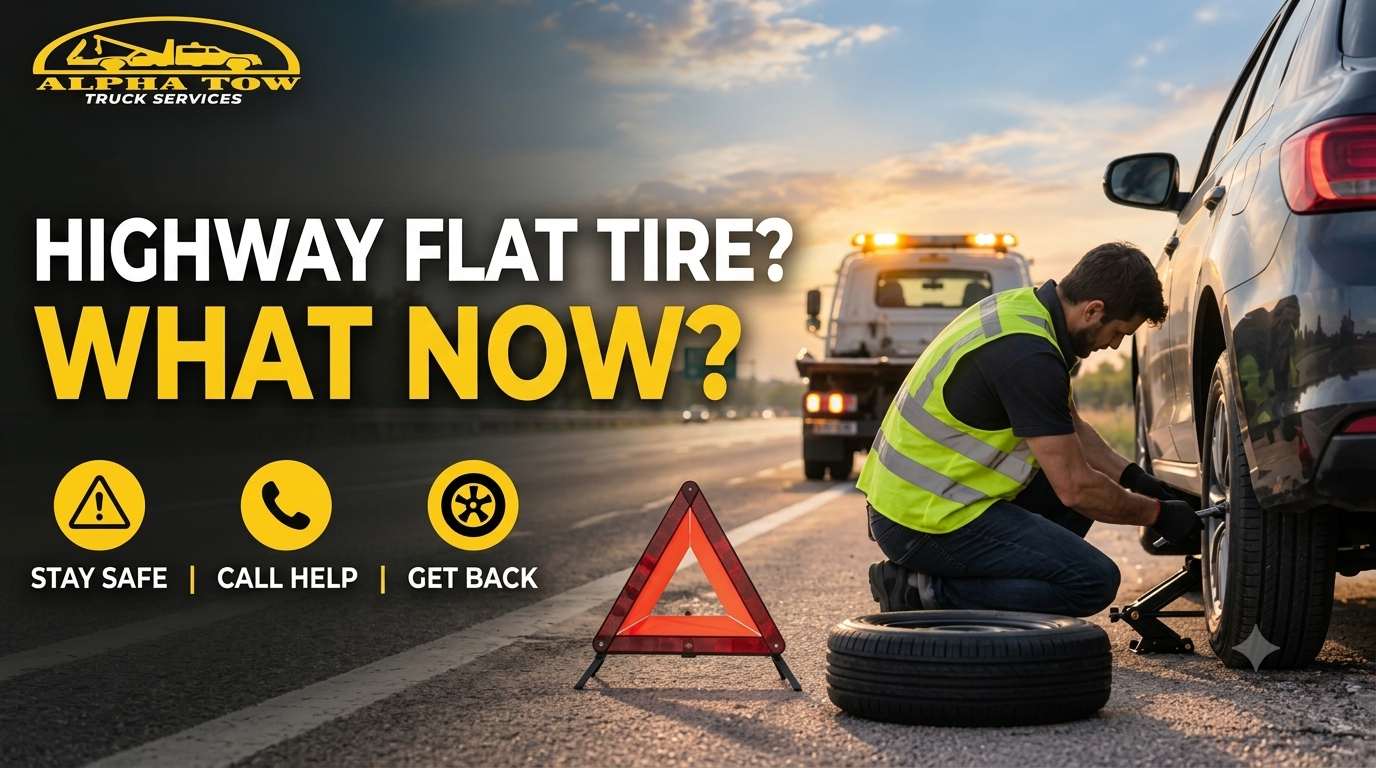
A flat tire on the highway can become dangerous within seconds. Between fast-moving traffic, narrow shoulders, poor visibility, and passing vehicles, trying to change a tire in the wrong location can put you at serious risk.
If you feel a sudden vibration, hear a flapping sound, or notice that your vehicle is pulling to one side, stay calm and focus on getting to a safe position. If the tire is completely flat or damaged, do not continue driving farther than necessary to reach a safe location.
The safest option may be to pull over, turn on your hazard lights, and call a professional flat tire change service.
Alpha Tow Truck Services provides roadside assistance for drivers who need help with flat tires, including situations where changing the tire yourself is unsafe or your vehicle does not have a usable spare.
What Should You Do Immediately After Getting a Flat Tire?
Your first priority is not changing the tire. It is getting yourself and your vehicle out of danger.
Follow these steps if you experience a flat tire on the highway.
Stay Calm and Reduce Your Speed
A sudden tire failure can cause your vehicle to pull, shake, or become difficult to control. Avoid making a sudden turn or slamming on the brakes.
Gradually reduce your speed while keeping both hands on the steering wheel. Try to maintain control and move toward the shoulder or another safe area when possible.
If the tire is losing air but the vehicle remains controllable, do not accelerate to reach your destination. Driving on a severely damaged tire can damage the wheel and create additional safety risks.
Move as Far Away From Traffic as Possible
If you can safely reach the shoulder, move your vehicle as far away from moving traffic as practical.
The ideal location is a wide, stable shoulder where there is enough space between your vehicle and passing traffic. If you cannot reach a safe shoulder without putting yourself at greater risk, stop in the safest location available.
Do not stop in a travel lane unless there is absolutely no alternative.
Turn On Your Hazard Lights
Once stopped, activate your hazard lights to make your vehicle more visible to approaching drivers.
This is especially important at night, during rain, in heavy traffic, or in areas where visibility is limited.
If you have warning triangles or other emergency equipment and can place them without entering a dangerous area, use them according to the manufacturer’s instructions. Never put yourself in the path of traffic just to make your vehicle more visible.
Do Not Stand Beside the Vehicle If It Is Unsafe
A common mistake is immediately getting out and inspecting the tire.
On a busy highway, standing next to your vehicle can expose you to passing traffic. A vehicle on the shoulder can still be struck by another driver who moves over unexpectedly or loses control.
If your location is unsafe, remain inside the vehicle with your seat belt fastened when appropriate and wait for professional assistance.
Should You Change the Tire Yourself?
Changing a tire yourself may be reasonable in a safe parking area or wide, protected location. A highway shoulder is a completely different situation.
Before attempting a tire change, consider:
- Is the shoulder wide enough to work safely?
- Is traffic moving quickly beside you?
- Is the ground level and stable?
- Is visibility good?
- Do you have a working spare tire?
- Do you have the correct jack and lug wrench?
- Can you safely access the tire?
- Are weather conditions suitable?
- Are you comfortable changing the tire?
If the answer to any of these questions creates doubt, calling a professional is usually the better choice.
A roadside flat tire service can help you avoid spending unnecessary time beside moving traffic while trying to perform a repair yourself.
When You Should Call a Flat Tire Change Service
You do not need to attempt a tire change just because you have a spare tire in your trunk.
Professional roadside assistance can be especially useful when:
You Are Stopped on a Busy Highway
Highway traffic creates a much greater risk than changing a tire in a driveway or parking lot.
If vehicles are passing close to your shoulder, call a professional flat tire change service instead of attempting the repair yourself.
You Don’t Have a Spare Tire
Many modern vehicles do not come with a traditional spare. Some use tire repair kits or run-flat tires instead.
If you do not have a usable spare, you may need professional roadside assistance or a mobile tire service to get you moving again.
Your Spare Tire Is Flat or Missing
A spare tire is only useful if it is properly inflated and in usable condition.
If your spare is flat, damaged, missing, or unsuitable for your vehicle, changing it is not an option. Professional tire assistance may be able to provide another solution or arrange transportation for your vehicle.
The Tire or Wheel Is Severely Damaged
A simple puncture is different from a destroyed tire.
If the tire has separated, the sidewall is severely damaged, the wheel is bent, or you have driven on the flat long enough to damage the tire, a standard tire change may not solve the problem.
In that situation, you may need a mobile tire service or towing to a tire shop.
You Are Driving a Larger Vehicle
Changing a tire on a larger vehicle can require heavier equipment and additional precautions.
If you are dealing with a commercial vehicle, truck, trailer, or another heavy vehicle, do not assume that the standard jack and spare-tire procedure applies.
Professional roadside assistance can help determine what equipment and service are appropriate.
What Is a Mobile Tire Service?
A mobile tire service brings tire assistance directly to your location instead of requiring you to drive to a tire shop.
This can be particularly convenient when you are stranded on the roadside and cannot safely drive the vehicle.
Depending on the situation and available equipment, mobile tire assistance may involve replacing a damaged tire, installing a spare, or helping determine the safest next step when the tire cannot be repaired at the roadside.
The biggest advantage is convenience: you do not have to risk driving on a damaged tire or arrange transportation to get help.
What Is an Emergency Tire Change?
An emergency tire change is roadside tire assistance provided when you need immediate help because a tire failure has left you stranded.
This can happen during the day, at night, during bad weather, or while traveling through an unfamiliar area.
The key difference is the urgency and location. You are not simply changing a tire at home—you are dealing with an unexpected tire problem while away from a safe repair location.
When requesting an emergency tire change, give the dispatcher:
- Your exact location
- The direction you are traveling
- Highway or road name
- Nearest exit or landmark
- Vehicle make and model
- Tire size if known
- Whether you have a spare
- Whether the tire or wheel has visible damage
- Whether you are safely parked on the shoulder
Accurate information helps the towing company determine what assistance may be required.
Why You Shouldn’t Drive on a Flat Tire
It can be tempting to drive slowly to the next exit or gas station after getting a flat.
However, driving on a completely flat tire can cause additional damage to the tire and wheel. It can also affect steering and vehicle stability.
Even if the distance appears short, there is no guarantee that the vehicle will remain controllable.
A tire that initially has a simple puncture can become severely damaged after being driven without adequate air pressure. What could have been a tire replacement may turn into a damaged wheel or a towing situation.
If the tire is flat and you are unsure whether the vehicle can safely move, stop and request roadside assistance.
What If You Have a Tire Blowout?
A blowout requires even more caution.
If a tire suddenly fails while you are traveling at highway speed:
- Keep both hands on the steering wheel.
- Avoid sudden braking.
- Gradually release the accelerator.
- Keep the vehicle moving straight.
- Reduce speed in a controlled manner.
- Move toward a safe shoulder when possible.
- Turn on your hazard lights once stopped.
- Get professional assistance if the vehicle cannot safely continue.
- Do not immediately attempt to inspect the damaged tire while standing beside the highway.
A blowout can leave tire debris around the vehicle and may also cause damage to the wheel, suspension, or body.
Flat Tire vs. Tire Damage: Why It Matters
Not every tire problem can be solved with a simple tire change.
A professional roadside technician needs to consider the condition of the tire, wheel, spare, and vehicle before determining the best solution.
For example:
| Situation | Possible Solution |
|---|---|
| Tire has lost air but is otherwise usable | Tire repair or inflation, when appropriate |
| Usable spare is available | Spare tire installation |
| No spare tire | Mobile tire assistance or towing |
| Damaged sidewall | Tire replacement |
| Bent or damaged wheel | Mobile assistance or towing |
| Multiple damaged tires | Mobile tire service or towing |
| Vehicle cannot safely move | Emergency roadside assistance or towing |
A professional assessment can prevent you from attempting a repair that is not safe or appropriate.
How a Roadside Flat Tire Service Helps
Calling professional roadside assistance can make a stressful highway breakdown much easier to manage.
Instead of standing beside traffic with a jack and lug wrench, you can contact a towing company and provide your location and vehicle information. The dispatcher can determine what type of assistance may be appropriate.
A professional roadside flat tire service can be especially valuable when:
- You are traveling alone.
- You are stranded at night.
- Weather conditions are poor.
- Traffic is heavy.
- You are unfamiliar with the area.
- Your vehicle does not have a spare.
- You cannot safely operate a jack.
- The tire or wheel appears seriously damaged.
The goal is not simply to replace the tire. It is to get you safely back on the road or determine the safest way to move the vehicle.
What Information Should You Have Ready When Calling?
When you call for a flat tire change service, having the right information can help speed up dispatch.
Tell the dispatcher:
Where you are:
Give the highway, direction of travel, nearest exit, mile marker, or recognizable landmark.
What happened:
Explain whether you have a slow leak, completely flat tire, blowout, or visible wheel damage.
What vehicle you have:
Provide the make, model, and approximate size or type of vehicle.
Whether you have a spare:
Let the dispatcher know if you have a spare tire and whether you know if it is properly inflated.
Your safety situation:
Explain whether you are on a wide shoulder, narrow shoulder, travel lane, parking area, or another location.
This information helps the dispatcher understand the urgency and determine the appropriate roadside solution.
How to Stay Safe While Waiting for Tire Assistance
Once help has been requested, avoid unnecessary activity around the vehicle.
Keep your hazard lights on and stay aware of traffic. If your location is unsafe, remain inside the vehicle when appropriate rather than standing on the shoulder.
Do not attempt to flag down passing motorists or walk along the highway looking for help.
If you are in an especially dangerous position, communicate that clearly to the dispatcher so the responding team understands the situation.
If there is an accident, injury, fire, or immediate danger, contact emergency services first.
Need a Flat Tire Change in Dallas-Fort Worth?
A flat tire on the highway is not just an inconvenience. It can quickly become a safety issue when you’re stopped near fast-moving traffic.
If you can safely change the tire in a protected location and have the necessary equipment, replacing the tire may get you moving again. But when the shoulder is narrow, traffic is heavy, visibility is poor, the tire is badly damaged, or you do not have a usable spare, professional assistance is the safer choice.
Alpha Tow Truck Services provides roadside assistance for drivers who need help with tire problems throughout the Dallas-Fort Worth area. Whether you need a flat tire change service, roadside flat tire service, mobile tire service, or an emergency tire change, calling a professional can save time while reducing the risks of working beside highway traffic.
If you’re stranded with a flat tire, call Alpha Tow Truck Services at (214) 225-6493 for roadside assistance and help getting your vehicle safely moving again.
Frequently Asked Questions
1. What should I do if I get a flat tire on the highway?
Slow down gradually, maintain control, move to a safe shoulder if possible, turn on your hazard lights, and avoid standing near moving traffic. If the tire cannot be safely changed where you are, call a professional roadside flat tire service.
2. Can I drive on a flat tire to reach the next exit?
It is generally best not to drive on a completely flat tire. Doing so can damage the tire, wheel, and other components while making the vehicle harder to control. If you cannot safely continue, request a flat tire change service or towing assistance.
3. What if I don’t have a spare tire?
If your vehicle does not have a usable spare, contact a mobile tire service for roadside assistance. Depending on the tire’s condition and available equipment, a technician may be able to provide a suitable solution at your location or arrange towing.
4. How long does an emergency tire change take?
The time depends on your location, traffic, vehicle type, tire condition, and whether a usable spare is available. Providing your exact highway location and vehicle information can help the dispatcher send the appropriate assistance.
5. Should I change a flat tire myself on the highway?
Only consider changing the tire yourself if your vehicle is in a safe, stable location away from moving traffic and you have the correct equipment. On a narrow or busy highway shoulder, calling professional roadside assistance is usually the safer option.
6. What is included in a roadside flat tire service?
A roadside flat tire service may include assistance with installing a spare tire or addressing certain tire-related problems at your location. If the tire, wheel, or vehicle cannot be safely serviced roadside, towing or additional mobile tire assistance may be necessary.
7. What should I do after a tire blowout?
Keep control of the vehicle, avoid sudden braking or steering, gradually reduce your speed, and move to a safe location when possible. Once stopped, turn on your hazard lights and request an emergency tire change or roadside assistance.
8. Can Alpha Tow Truck Services help with flat tires?
Yes. Alpha Tow Truck Services provides roadside assistance for drivers dealing with flat tires and other roadside emergencies in the Dallas-Fort Worth area. Call (214) 225-6493 to request assistance.
Conclusion
A flat tire on the highway is more than an inconvenience—it can become a serious safety concern when you’re stopped beside fast-moving traffic. Your first priority should always be getting to a safe location rather than immediately attempting to change the tire.
If you have a usable spare and enough space to work safely, you may be able to replace the tire yourself. However, when traffic is heavy, the shoulder is narrow, visibility is poor, you don’t have a spare, or the tire and wheel are badly damaged, professional assistance is the safer and more convenient option.
Alpha Tow Truck Services provides flat tire change service, roadside flat tire service, mobile tire service, and emergency tire change assistance throughout the Dallas-Fort Worth area. If you’re stranded with a flat, call (214) 225-6493 and let the roadside team help you get back on the road safely.