
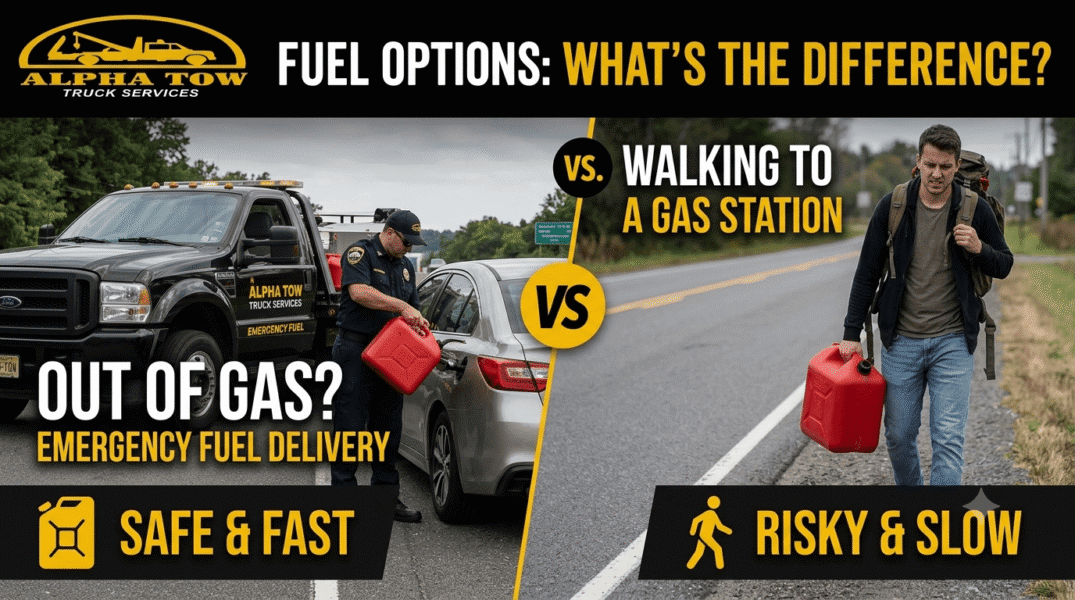
Emergency Fuel Delivery vs. Walking to a Gas Station: Which Is Safer?
Emergency fuel delivery is almost always the safer and faster option compared to walking to a gas station — especially on a highway shoulder, in bad weather, or after dark. A mobile fuel delivery technician brings gas or diesel directly to your vehicle, typically within 30 to 45 minutes, without you ever having to leave the relative safety of your car or walk along an active roadway.
Running out of gas is one of those breakdowns that feels almost embarrassing — no mechanical failure, no dramatic warning light, just an empty tank and a car that won’t move. The instinct for a lot of drivers is to just walk to the nearest gas station, grab a canister, and solve it themselves. It sounds simple. In practice, it’s often the riskier, slower, and more frustrating choice compared to calling an emergency fuel delivery service.
This guide breaks down exactly how the two options compare — safety, response time, and overall convenience — so you can make the smarter call the next time your tank hits empty in an inconvenient spot.
The Real Risks of Walking to a Gas Station
Walking for gas seems like the free, self-sufficient option, but it comes with risks that aren’t always obvious until you’re actually doing it.
Walking Along or Near Traffic
If your car ran out of gas on a highway shoulder, frontage road, or anywhere without a sidewalk, walking means sharing space with moving vehicles, often at highway speeds, often with limited visibility for drivers to see you. This is one of the most common ways stranded motorists get seriously injured, and it’s an entirely avoidable risk.
Leaving Your Vehicle and Belongings Unattended
Walking away means leaving your car, and everything in it, alone on the roadside — sometimes for 20 minutes or more each way. That’s a real consideration in an unfamiliar area, at night, or if you have valuables visible inside.
Distance and Physical Limitations
Not every breakdown happens conveniently close to a gas station. Depending on where you’re stranded, the nearest station might be a mile or several miles away — a serious problem in extreme Texas heat, in the rain, or if you’re not physically able to make that walk comfortably.
The Container Problem
Even after reaching a station, you still need a proper, safe gas container — not always something a station keeps in stock — plus the walk back carrying several pounds of fuel, followed by carefully transferring it into your tank roadside.
How Emergency Fuel Delivery Actually Works
A roadside fuel delivery service works far more simply than most drivers expect. You call, describe your location and vehicle, and specify whether you need gasoline or diesel fuel delivery. A technician is dispatched directly to you, arrives with proper fuel containers and safety equipment, and adds enough fuel to get you safely to the nearest station — no walking, no waiting outside your vehicle, no risk of misjudging distance in the heat.
The entire process typically takes less time than the walk alone would, and you never have to leave your car unattended or exposed to passing traffic.
Safety Comparison: Fuel Delivery vs. Walking
Walking exposes you to moving traffic, especially on shoulders and frontage roads with no pedestrian space. A mobile fuel delivery technician comes to you, so you can stay inside your locked vehicle the entire time.
Walking means leaving your car and belongings unattended for the full round trip. With roadside fuel service, your vehicle is never left alone — you’re right there when help arrives.
Walking in extreme heat, rain, or after dark adds real physical risk and reduced visibility. A fuel delivery service removes that risk entirely, since you’re not the one walking.
Response Time: What’s Actually Faster
It’s a common assumption that walking is the faster fix, but that’s rarely true once you account for the whole process. Walking to a station a mile away, waiting to buy a container and fuel, and walking back easily adds up to 40 minutes or more — often longer in heat or bad weather, and that’s before you’ve actually gotten the car running.
A dispatched emergency fuel delivery service typically reaches a stranded driver in the DFW area within 30 to 45 minutes, and once the technician arrives, refueling takes only a few minutes. In many cases, the total time from the first phone call to being back on the road is comparable to or faster than the walking route — without any of the added risk.
Convenience: Why Most Drivers Prefer Delivery
- No need to locate a gas container, which many drivers simply don’t own
- No carrying several pounds of fuel any distance on foot
- No risk of spilling fuel on yourself or in your vehicle during a roadside transfer
- Diesel fuel delivery available for drivers whose vehicles don’t run on standard gasoline — something a typical gas station canister purchase can’t necessarily solve if the station is out of diesel
- You stay with your vehicle and belongings the entire time
When Walking Might Make Sense
There are limited situations where walking is genuinely reasonable — you’re in a safe, well-lit area with a proper sidewalk, the station is a short and clearly safe distance away, and you’re comfortable leaving your vehicle briefly. Even then, it’s worth weighing that convenience against simply calling for mobile fuel delivery and staying safely with your car the entire time.
What to Do the Moment You Run Out of Gas
- Coast to the safest available spot — a shoulder, parking lot, or side street, not a live lane
- Turn on your hazard lights immediately
- Stay inside your vehicle if you’re near moving traffic
- Call for emergency fuel delivery and provide your exact location and fuel type needed
- Avoid repeatedly trying to restart the engine, which can drain your battery unnecessarily
FAQs: Emergency Fuel Delivery
How much does emergency fuel delivery typically cost?
Pricing usually includes a service fee plus the cost of the fuel itself, confirmed upfront before dispatch so there are no surprises when the technician arrives.
Can I get diesel fuel delivery, or is it gas only?
Most mobile fuel delivery services carry both gasoline and diesel, so be sure to specify your vehicle’s fuel type when you call.
How much fuel does a delivery typically provide?
Enough to safely reach the nearest gas station and fill up properly — typically a few gallons, not a full tank.
Is it actually dangerous to walk on a highway shoulder for gas?
Yes. Highway shoulders see a meaningful number of secondary crashes involving pedestrians and stopped vehicles each year, which is exactly why staying with your car and calling for roadside fuel service is the safer choice.
How fast can a fuel delivery technician reach me?
In the DFW area, response times are typically 30 to 45 minutes depending on your location and current demand.
The Bottom Line
Running out of gas doesn’t have to mean a risky walk along a busy road or leaving your car unattended in an unfamiliar area. An emergency fuel delivery service brings the fuel to you — safely, quickly, and without the physical risk of walking in heat, rain, or low visibility.
If you’re stranded with an empty tank anywhere across Dallas-Fort Worth, Alpha Tow Truck Services offers fast, reliable mobile fuel delivery — gas or diesel — 24/7, so you can stay safe inside your vehicle while help comes directly to you.