
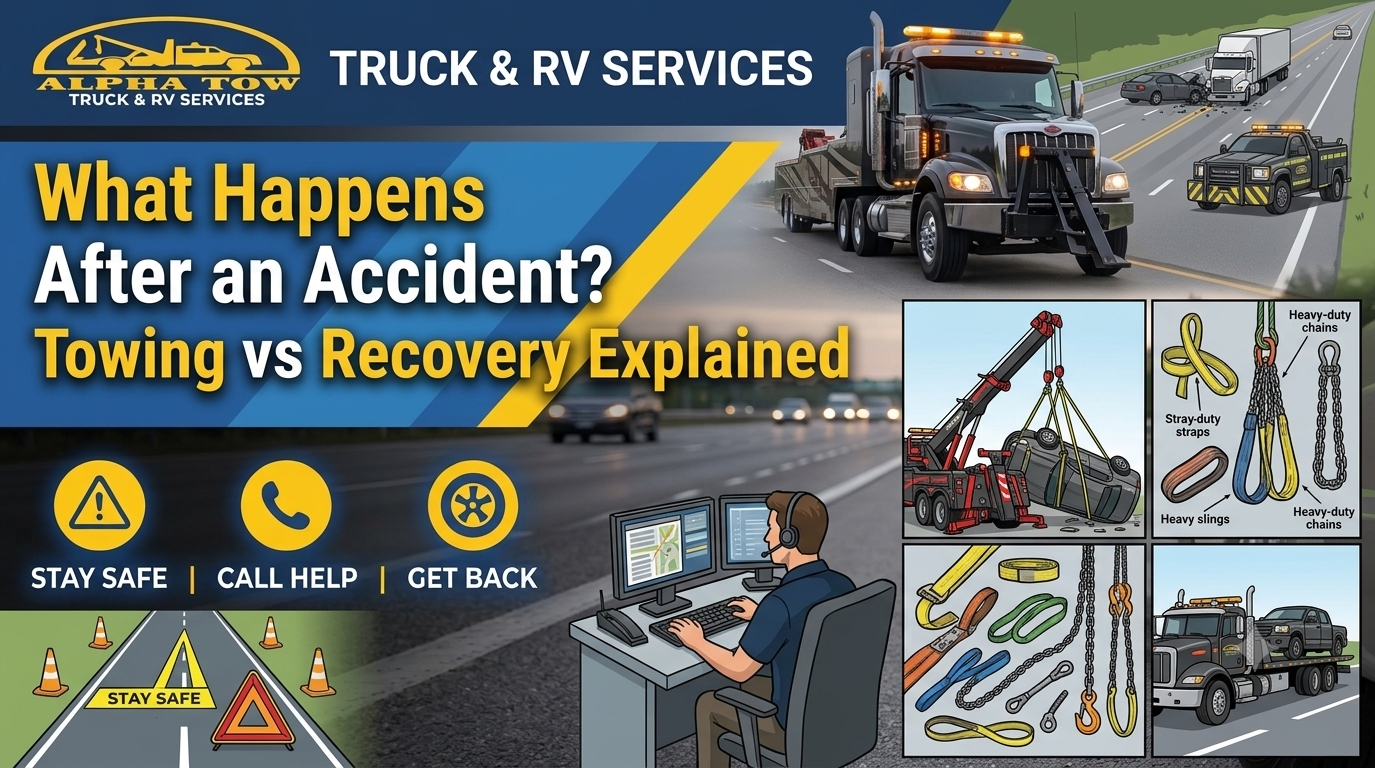
A vehicle accident can leave you with more than a damaged car. You may be sitting on the shoulder with a vehicle that cannot move, wondering whether you need a regular tow truck, a wrecker, or a full accident recovery. The answer depends on the vehicle’s condition, where it ended up, and whether it can be safely loaded and transported.
Understanding the difference can help you request the right assistance instead of sending a standard tow truck to a situation that requires recovery equipment.
What Happens Immediately After a Vehicle Accident?
Your first priority after an accident should be safety. If possible, move yourself and passengers away from traffic and into a safe location. Turn on your hazard lights and contact emergency services when necessary, particularly if anyone is injured or the accident is blocking a roadway.
Once the immediate safety concerns are handled, you need to determine whether the vehicle can be driven.
Even when a vehicle starts after a collision, driving it may not be safe. Damage to the steering, suspension, wheels, brakes, lights, tires, or other components can create another hazard.
This is where emergency towing or accident recovery may become necessary.
Alpha Tow Truck Services describes emergency towing as assistance for accidents, breakdowns, and situations where a vehicle cannot safely continue. Its wrecker service handles more complicated post-collision recovery, including vehicles that require pulling, extraction, or repositioning.
Towing vs. Recovery: What Is the Difference?
The easiest way to understand the difference is to think about transport versus access.
A tow is primarily about transporting a vehicle.
Recovery is about getting the vehicle into a position where it can be safely moved.
| Situation | Towing | Recovery |
|---|---|---|
| Vehicle is safely on the roadway | Usually | Usually not needed |
| Vehicle has collision damage but can be loaded | May be needed | Depends on position |
| Vehicle is in a ditch | Usually not enough by itself | Usually needed |
| Vehicle has rolled over | Not usually enough | Specialized recovery needed |
| Vehicle is stuck off-road | May require recovery first | Usually needed |
| Vehicle is blocking a roadway | May be needed after recovery | May be needed first |
| Vehicle needs transport to a repair shop | Yes | Sometimes followed by towing |
The exact equipment depends on the vehicle and accident scene.
When Do You Need a Tow Truck After an Accident?
A tow truck after an accident may be appropriate when the vehicle is damaged but remains accessible and can be safely loaded.
For example, imagine a sedan involved in a collision at an intersection. The vehicle has a damaged bumper and front-end components, but it is sitting upright on the road and can be accessed by a tow operator.
In that situation, a tow truck may be able to load the vehicle and transport it to a repair facility.
Other common reasons to request towing after an accident include:
- The vehicle cannot start.
- The wheels or tires are damaged.
- The steering system is affected.
- The vehicle has significant body or mechanical damage.
- Driving the vehicle could create another safety risk.
- Police or roadside conditions require the vehicle to be removed.
- You need transportation to a repair shop, dealership, or secure location.
The important point is that starting the engine does not automatically mean the vehicle is safe to drive.
When Does an Accident Become a Recovery Job?
A collision becomes more complicated when the vehicle is no longer sitting normally on the roadway.
For example, a vehicle may slide into a ditch, roll onto its side, become stuck against an embankment, or end up in another difficult position.
This is where a wrecker service can be different from ordinary towing.
A wrecker uses equipment such as winches, rigging, and recovery systems to pull, reposition, or extract vehicles. Alpha’s current wrecker service specifically describes post-collision recovery, ditch extractions, rollovers, and difficult vehicle extractions as recovery situations.
What Is Accident Recovery?
Accident recovery is the process of safely removing a vehicle from the accident scene when ordinary towing alone is not enough.
Assessing the vehicle
The operator needs to understand how the vehicle is positioned and what was damaged during the collision.
Checking the surrounding area
Traffic, roadside barriers, ditches, slopes, other vehicles, and debris can affect how the recovery should be performed.
Selecting the equipment
The required equipment depends on the vehicle’s size, weight, position, and condition.
Stabilizing the vehicle
A vehicle that has rolled over or is sitting at an unusual angle may need to be stabilized before it can be moved.
Extracting the vehicle
Winches, rigging, or other recovery equipment may be used to bring the vehicle back to a safe position.
Transporting the vehicle
Once the vehicle is safely accessible, it can be loaded or connected for transportation to the appropriate destination.
This is why accident recovery and towing are related but not always the same job.
Why the Right Equipment Matters After an Accident
Not every tow truck is designed for every recovery situation.
A standard tow truck may be appropriate for a straightforward vehicle transport, while a collision involving a rollover, ditch, or difficult extraction can require a wrecker.
The same principle applies to larger vehicles. Alpha’s service lineup separates standard emergency towing from heavy-duty and specialized recovery services because vehicle size and condition affect the equipment required.
When you call, provide as much information as possible:
| Information to Give | Why It Matters |
|---|---|
| Vehicle type | Helps determine equipment |
| Exact location | Allows the operator to find the accident scene |
| Vehicle position | Shows whether recovery may be necessary |
| Visible damage | Helps identify potential towing limitations |
| Whether anyone is injured | Determines whether emergency services are still needed |
| Whether the vehicle can move | Helps distinguish towing from recovery |
| Road or shoulder condition | Helps the operator prepare for the scene |
Should You Call Towing or Recovery After an Accident?
You don’t necessarily need to know the technical answer before making the call.
If you’re unsure whether you need towing or recovery, describe what happened and where the vehicle ended up. A professional dispatcher can use that information to determine what type of assistance is appropriate.
For example:
That sounds more like a towing situation.
Compare that with:
That may require a recovery-focused response.
The difference is not simply the amount of damage. The vehicle’s position and accessibility can be just as important.
What Should You Do While Waiting for a Tow Truck After an Accident?
If you’re waiting for assistance, stay in a safe location whenever possible.
Avoid standing directly behind or in front of the disabled vehicle, particularly on a busy highway. If the vehicle is in an unsafe position or traffic is approaching at speed, contact emergency services and follow their instructions.
You should also avoid attempting to pull the vehicle out yourself. Accident-damaged vehicles can have hidden mechanical or structural damage, and improvised recovery can make the situation worse.
If the vehicle is blocking traffic, tell the dispatcher that when you call. Accurate information helps the towing or recovery team understand what they may encounter.
Frequently Asked Questions
Is towing the same as accident recovery?
No. Towing usually involves transporting an accessible vehicle, while recovery can involve extracting or repositioning a vehicle that is stuck, overturned, off the roadway, or otherwise difficult to access.
Do I need a wrecker after every accident?
No. A wrecker is generally needed when the vehicle requires specialized recovery equipment. A straightforward collision where the vehicle remains accessible may only require towing.
Can a tow truck tow a badly damaged vehicle?
It depends on the vehicle’s condition and how it is positioned. Steering, wheel, suspension, body, and structural damage can affect how the vehicle must be loaded and transported.
What should I tell the towing company after an accident?
Give the exact location, vehicle type, whether anyone is injured, whether the vehicle can move, and how the vehicle is positioned. Mention if it is in a ditch, on its side, overturned, or blocking traffic.
What is a wrecker service used for?
A wrecker service is commonly used for more difficult recovery situations such as post-collision extraction, ditch recovery, rollovers, and vehicles that cannot simply be hooked up and transported.
Can emergency towing take my vehicle to a repair shop?
Yes. Emergency towing can transport a vehicle that cannot safely continue to a repair shop, dealership, home, or another appropriate destination.
Conclusion
After an accident, the biggest question is not simply, “Do I need a tow?” It is “What does my vehicle need to be moved safely?”
If the vehicle is accessible and can be loaded safely, towing may be enough. If it has gone into a ditch, rolled over, become unstable, or requires extraction, accident recovery may be necessary before transportation can begin.
Knowing the difference between towing and recovery can help you describe the situation accurately and get the right equipment to the scene. Alpha Tow Truck Services provides emergency towing and specialized wrecker service across the DFW area, including post-collision recovery and difficult vehicle extractions.