
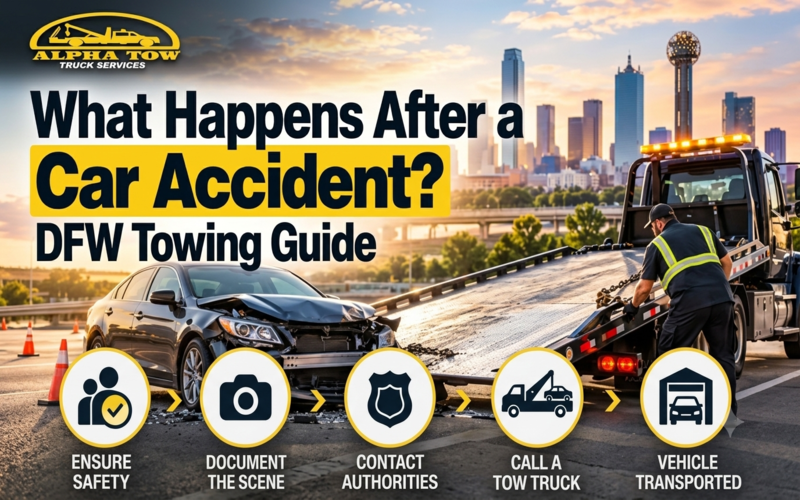
A car accident can turn an ordinary drive through Dallas-Fort Worth into a stressful roadside situation in seconds.
Once you know everyone is safe, another question quickly comes up:
What happens to the car now?
If the vehicle has significant body damage, leaking fluids, broken steering or suspension components, damaged wheels, deployed airbags, or another condition that makes driving unsafe, it may need to be towed from the accident scene.
Understanding how accident towing works can make those first confusing minutes easier to manage.
Here’s what DFW drivers should know about the process—from the moments immediately after a collision to getting the damaged vehicle to a repair shop, storage location, or another appropriate destination.
What Should You Do Immediately After a Car Accident?
Your first priority is people, not the vehicle.
Check yourself and your passengers for injuries. If anyone is injured, the crash creates an immediate hazard, or emergency assistance is otherwise required, call 911.
If the vehicle can be moved safely and doing so is appropriate for the situation, getting out of active traffic can reduce the risk of another collision. Turn on the hazard lights and remain aware of surrounding traffic.
Then begin documenting what happened.
Useful information may include:
- Photos of vehicle damage
- Wide photos of the accident scene
- License plates
- Other driver’s contact information
- Insurance information
- Witness information
- Road and weather conditions
- Police report or incident information when applicable
Avoid standing in an unsafe traffic lane just to take photographs.
Your safety matters more than documenting a particular angle.
How Do You Know If Your Car Needs Towing After an Accident?
Not every collision leaves a vehicle completely disabled.
But a car being able to move doesn’t necessarily mean it is safe to drive.
Signs You Should Consider a Tow
| Vehicle Condition | Why Towing May Be Necessary |
| Steering feels abnormal | Steering or suspension components may be damaged |
| Wheel or tire is badly damaged | Driving could cause further damage or loss of control |
| Fluids are leaking | The vehicle may have mechanical or cooling-system damage |
| Airbags deployed | The vehicle needs professional inspection |
| Lights are badly damaged | The vehicle may not be safe or suitable for road use |
| Parts are dragging | Driving could damage the vehicle or create a road hazard |
| Severe body damage | Hidden mechanical or structural damage may exist |
| Vehicle won’t start | It cannot leave the scene under its own power |
When you’re uncertain, avoiding an unnecessary drive is usually wiser than risking additional vehicle damage or another incident.
What Happens When a Tow Truck Arrives at an Accident?
Accident towing can involve more than hooking up a car and driving away.
The operator first needs to assess the vehicle’s position and condition.
A car sitting normally on the shoulder presents a very different recovery situation from one that has left the roadway, has damaged wheels, cannot roll, or is positioned among crash debris.
The towing operator may evaluate:
Vehicle type and size: A passenger sedan, large pickup, EV, SUV, and commercial vehicle may require different equipment.
Vehicle condition: Damaged steering, suspension, wheels, or body components can change how the vehicle should be loaded.
Position: A vehicle in a ditch, median, or difficult angle may require recovery before towing.
Drivetrain and configuration: The correct towing method should be selected for the particular vehicle.
Once the vehicle can be safely loaded or connected, it can be transported to the agreed destination.
Where Does Your Car Go After an Accident?
This is one of the most common questions drivers have.
Depending on the circumstances, a damaged car might be transported to:
- A collision repair shop
- A mechanic
- A dealership
- A storage facility
- Your home
- Another authorized location
Where the vehicle goes may also depend on law-enforcement requirements, insurance arrangements, the severity of the collision, and whether you can choose a destination at the scene.
If you are arranging your own tow, ask where the vehicle will be taken before it leaves.
Write down the towing company’s details and destination so you know exactly where the car is going.
Flatbed vs. Wheel-Lift Towing After an Accident
The right towing method depends on the vehicle and its condition.
Flatbed Towing
A flatbed carries the vehicle with its wheels off the road.
It can be particularly useful when a vehicle has substantial accident damage, cannot roll normally, has drivetrain considerations, or otherwise needs to be transported without its wheels traveling on the roadway.
Wheel-Lift Towing
A wheel-lift raises one end of the vehicle while the other wheels remain on the road.
It can be suitable for many towing situations, depending on vehicle type, drivetrain, condition, and manufacturer requirements.
There isn’t one towing method that’s automatically correct for every collision.
A qualified operator should determine what equipment is appropriate after evaluating the damaged vehicle.
What If Your Car Is in a Ditch or Off the Road?
This is where accident recovery differs from a straightforward tow.
A vehicle may need to be recovered before it can be transported.
For example, a car might be:
- In a ditch
- Stuck in mud or soft ground
- Against a barrier
- Facing the wrong direction
- Partially off an embankment
- Unable to roll because of wheel damage
These situations may require a wrecker or other recovery equipment to reposition the vehicle safely.
Alpha Tow Truck Services specifically lists post-collision recovery and ditch extractions as part of its wrecker service in DFW. Alpha Tow Truck Services
Can You Choose Your Towing Company After an Accident?
The answer can depend on the circumstances surrounding the crash.
If you’re able to arrange towing yourself, having the number of a local towing company saved beforehand can make the process easier.
However, some accident scenes are controlled by law enforcement, particularly when a vehicle is obstructing traffic, the driver cannot arrange a tow, or other circumstances require prompt removal.
The important practical rule is:
Ask questions before agreeing whenever circumstances allow.
Confirm the company, destination, towing arrangement, and expected charges.
What Information Should You Give the Towing Dispatcher?
Accurate information helps the dispatcher send appropriate equipment the first time.
Be prepared to provide:
- Your location
- Vehicle make and model
- Vehicle type
- Nature of the collision
- Whether the vehicle rolls
- Whether wheels appear damaged
- Whether the vehicle is in a ditch or roadway
- Your preferred destination, if known
Location details are particularly important around DFW.
If you’re on a freeway, provide the highway, direction of travel, nearest exit, cross street, or recognizable landmark whenever possible.
For example, “I-635 eastbound near the Plano Road exit” is considerably more useful than “somewhere near Dallas.”
How Does Accident Towing Work on Busy DFW Highways?
Dallas-Fort Worth drivers routinely travel major routes such as I-35E, I-30, I-635, US-75, US-80, and the area’s toll roads.
An accident on a high-speed roadway creates additional hazards because surrounding traffic may continue moving at highway speeds.
If you’re waiting for towing assistance:
Stay away from active traffic whenever possible.
Follow instructions from police, firefighters, or other emergency personnel at the scene.
Do not attempt repairs in an unsafe lane.
Make your location as precise as possible when contacting dispatch.
Alpha Tow Truck Services operates across Dallas and the wider DFW Metroplex, including Plano, Garland, Irving, Rowlett, Mesquite, McKinney, and Richardson. Its emergency towing service includes accident and disabled-vehicle calls. Alpha Tow Truck Services
What Should You Do Before Your Damaged Car Is Towed?
If conditions are safe and you have time, take a few simple steps.
Remove important personal belongings you may need immediately, such as your wallet, phone, house keys, medication, work equipment, or child items.
Photograph the vehicle’s condition before towing.
Confirm:
Who is towing it?
Where is it going?
How can you retrieve it or access it later?
Who should your insurance company contact?
Keeping this information together can make the next stage much easier.
What Happens After the Tow?
Once the immediate roadside situation is over, attention shifts toward insurance, repairs, and transportation.
Notify your insurer if you haven’t already done so.
Provide the information you’ve collected and confirm where the vehicle is located.
Depending on the damage, an adjuster or repair facility may then inspect the vehicle to determine whether repairs are appropriate or whether the vehicle may be considered a total loss.
Keep towing receipts and other accident-related documentation.
Don’t assume that because the car has been removed from the scene, the process is finished.
Mistakes to Avoid After a DFW Car Accident
Stress makes it easy to overlook basic details.
Try to avoid:
Driving a visibly damaged vehicle simply because it still starts. Hidden wheel, steering, suspension, or cooling-system damage can make continued driving unsafe.
Leaving without knowing where your car is going. Get the towing destination and company details.
Forgetting personal belongings. Access may become less convenient after the vehicle reaches another facility.
Failing to document the damage. Photos taken at the scene can be useful later.
Standing in traffic while waiting. Vehicle damage can be repaired; your safety comes first.
Need Accident Towing in Dallas-Fort Worth?
When an accident leaves your car unable to continue safely, getting it out of traffic and transported properly becomes the priority.
Alpha Tow Truck Services provides 24/7 towing and roadside assistance across the Dallas-Fort Worth Metroplex. Its emergency towing service handles accidents and disabled vehicles, while its wrecker service covers situations such as post-collision recovery and ditch extraction. Alpha Tow Truck Services
The key is giving dispatch accurate information about the vehicle and crash so the appropriate equipment can be sent.
Conclusion
After a car accident, focus first on safety and injuries. Then document the scene, exchange necessary information, and determine whether the vehicle can genuinely be driven safely.
If it can’t, accident towing is the bridge between the crash scene and what happens next.
Knowing the towing company, destination, vehicle condition, and recovery requirements helps prevent confusion at an already stressful moment.
For DFW drivers, it is worth knowing these steps before an accident happens—not trying to learn them while standing beside a damaged vehicle on a busy Dallas highway.
Frequently Asked Questions
Should I tow my car after a minor accident?
Not necessarily. However, if the vehicle has damaged wheels, steering problems, leaking fluids, deployed airbags, dragging components, or anything else that makes you question its safety, professional assessment and towing may be appropriate.
Can a tow truck move a badly damaged car?
Often, yes. The equipment needed depends on the damage and position of the vehicle. Some crashes require recovery equipment before the vehicle can be towed.
Where will my car be taken after an accident in DFW?
It may go to a repair facility, dealership, storage facility, your home, or another authorized destination depending on the circumstances.
What should I tell a towing company after an accident?
Give the dispatcher your exact location, vehicle type, condition, whether it can roll, any obvious wheel damage, whether it is off the road, and your intended destination if known.
Do accident-damaged cars always need flatbed towing?
No. The correct method depends on the vehicle, drivetrain, damage, and position. A professional towing operator should determine the appropriate equipment.
Does Alpha Tow Truck Services provide accident towing in DFW?
Yes. Alpha lists accidents and disabled vehicles among the situations handled through its 24/7 emergency towing operation across Dallas-Fort Worth.