
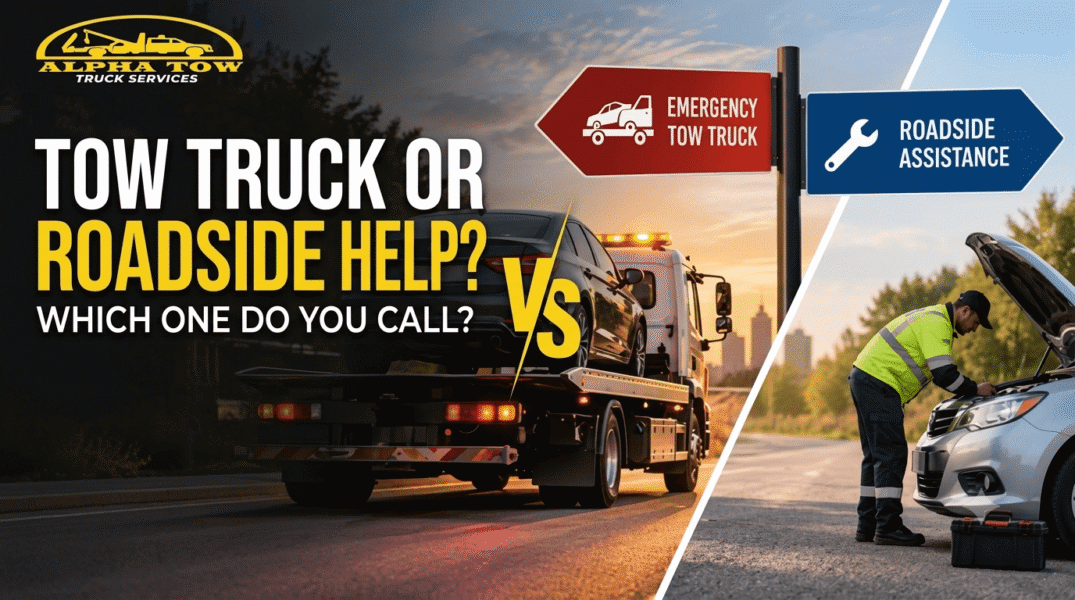
A vehicle problem does not always require a tow. Sometimes a jump start, tire change, fuel delivery, or lockout service can get you safely back on the road. But when your vehicle cannot be driven safely, continuing to wait for a roadside fix can create unnecessary risks.
That is where knowing the difference between roadside assistance vs. towing becomes important.
Roadside assistance is generally intended to resolve smaller problems at the location, while an emergency towing service is needed when the vehicle must be transported somewhere else. For example, a dead battery may only require a jump start, but a vehicle with major engine damage, accident damage, or a serious mechanical failure may need an emergency tow truck.
Knowing which service to request can help you get the right equipment faster, stay safer while stranded, and avoid wasting time on a repair that cannot solve the problem.
Roadside Assistance vs. Towing: What’s the Difference?
Roadside assistance is designed to address problems that may be resolved where your vehicle is located. Common examples include:
- Dead battery or jump-start needs
- Flat tire changes
- Running out of fuel
- Vehicle lockouts
- Minor mechanical problems
- Other situations where the vehicle may become operational again on-site
Towing is different because the vehicle needs to be transported. If it cannot be safely driven or a roadside technician cannot make it operational, towing becomes the practical next step. Roadside assistance programs commonly include towing as one possible service when a vehicle cannot safely continue driving.
The simplest way to think about it is:
When Should You Call an Emergency Tow Truck?
The biggest factor is safety. If driving the vehicle could put you, your passengers, or other motorists at risk, do not attempt to continue the trip simply because you are close to your destination.
Here are some situations when an emergency tow service is usually the better choice.
Your Vehicle Cannot Be Safely Driven
A vehicle that starts does not necessarily mean it is safe to drive.
You may have a serious steering problem, brake issue, overheating engine, transmission failure, damaged suspension, or another mechanical problem that makes continued driving dangerous. Attempting to limp the vehicle to a repair shop could turn a manageable breakdown into a much more expensive repair.
If the vehicle is unsafe or undriveable, an emergency tow truck can transport it to a repair facility or another secure location.
You Have Been Involved in an Accident
After a collision, visible damage is not always the full story. Steering, suspension, wheels, brakes, electrical systems, and other components may be affected even when the vehicle appears driveable.
If the vehicle has significant damage, is leaking fluids, has deployed airbags, or cannot be operated normally, towing may be safer than trying to drive away from the scene.
An emergency towing service can help move the vehicle away from an unsafe location and transport it to a repair facility or other appropriate destination.
You Break Down on a Highway
A breakdown on a highway presents a different level of risk from a vehicle that stops in a driveway or parking lot.
Fast-moving traffic, limited shoulder space, poor visibility, and nighttime conditions can make remaining beside the vehicle dangerous. If your vehicle cannot be repaired quickly and safely where it sits, getting it removed from the roadway may be the safest option.
In these situations, response time matters. A reliable emergency tow service should be able to collect information about your location, vehicle, and situation so the appropriate truck can be dispatched.
A Roadside Repair Cannot Solve the Problem
Sometimes you call roadside assistance expecting a quick fix, only to discover that the problem is more serious.
For example, a technician may determine that a battery cannot simply be jump-started, a tire cannot be safely changed, or a mechanical issue requires shop-level repair.
Roadside assistance does not necessarily mean the vehicle will be fixed on-site. If the vehicle remains undriveable, towing may be the next step.
Continuing to Drive Could Cause More Damage
A warning light or unusual noise does not always mean you need an immediate tow. However, some symptoms should not be ignored.
Stop driving and consider an emergency tow if you experience:
- Severe engine overheating
- Loss of braking ability
- Steering problems
- Major fluid leaks
- Loud grinding or severe mechanical noises
- Transmission failure
- Significant collision damage
- Smoke or burning smells
- A wheel or suspension problem
When you are unsure whether driving is safe, it is better to have the vehicle assessed than to risk additional damage or a roadside accident.
When Roadside Assistance Is the Better Choice
Not every roadside problem requires an emergency tow truck.
If your vehicle is safely positioned and the problem is relatively simple, roadside assistance may be faster and more convenient.
Dead Battery
If your engine will not start because of a dead battery, a jump-start service may get you moving without requiring a tow. Some roadside providers can also test or replace a battery at the vehicle’s location.
Flat Tire
A flat tire may only require a spare tire installation. If the vehicle has a usable spare and the wheel and tire are otherwise safe, an on-site tire change can get you back on the road.
If there is no spare, the tire or wheel is badly damaged, or the vehicle cannot be safely handled roadside, towing may become necessary.
Locked Keys in the Vehicle
A vehicle lockout usually does not require towing. A roadside technician or locksmith can often help you regain access without moving the vehicle.
Empty Fuel Tank
Running out of fuel is another situation where roadside assistance can be more convenient than towing. Fuel delivery can get you enough fuel to reach a nearby gas station and continue your trip.
Why Response Time Matters During an Emergency
When you are stranded, response time is more than a convenience issue. It can directly affect your safety.
Consider a vehicle stopped on the shoulder of a busy highway. The longer you remain exposed to passing traffic, the longer you are dealing with a potentially hazardous environment.
That is why choosing a towing company with an active dispatch operation can make a difference.
Alpha Tow Truck Services operates a live 24/7 dispatch system throughout the Dallas-Fort Worth area. The company states that emergency towing requests are handled by a live dispatcher and that standard vehicles generally have a 30–45 minute target response window, depending on location and traffic.
When requesting an emergency tow truck, provide your exact location, vehicle type, direction of travel if you are on a highway, and a short description of the problem. Accurate information helps dispatch determine what type of truck and equipment may be appropriate.
What Makes Emergency Towing More Convenient?
Calling the right service the first time can save you from unnecessary delays.
If you know that the vehicle cannot be safely driven, requesting towing immediately allows the dispatcher to focus on vehicle recovery rather than sending assistance that cannot resolve the underlying problem.
A good emergency towing process should include:
- A live point of contact so you can explain what happened.
- Accurate location information so the driver can find you.
- Vehicle details so the right equipment can be selected.
- A realistic ETA based on traffic and current availability.
- Clear pricing information before dispatch whenever possible.
- A safe destination such as a repair shop, home, dealership, or other appropriate location.
Alpha Tow Truck Services states that its dispatch team considers the vehicle’s type, size, weight, condition, and location when determining the appropriate towing solution.
What Should You Do While Waiting for an Emergency Tow?
Once you have requested an emergency tow service, focus on staying safe.
If you are on a highway and the vehicle can be moved safely, get as far away from moving traffic as practical. Turn on your hazard lights and remain aware of surrounding traffic.
If leaving the vehicle would put you at greater risk, stay inside with your seat belt fastened when appropriate. Avoid standing directly beside the vehicle or walking into traffic to inspect a problem.
At night or in poor weather, visibility becomes even more important. Follow the instructions provided by your dispatcher and avoid attempting repairs in a dangerous location.
If there is an immediate threat involving fire, serious injury, an active collision, or another dangerous situation, contact emergency services first.
Emergency Towing or Roadside Assistance? Use This Simple Rule
Still unsure which service you need?
Use this basic decision:
Can the vehicle safely continue driving after a roadside fix?
- Yes: Roadside assistance may be the right choice.
- No: Request an emergency tow.
- Not sure: Explain the symptoms to the dispatcher and ask what service is appropriate.
For example, a dead battery with no other problems may need a jump start. A vehicle with a failed transmission may need towing. A flat tire with a usable spare may need a tire change, while a vehicle with a damaged wheel may need transportation.
The goal is not simply to get the fastest service. It is to get the right service for the situation.
Get Emergency Towing Help in Dallas-Fort Worth
A roadside breakdown can become stressful quickly, especially when you are dealing with traffic, nighttime conditions, an accident, or a vehicle that cannot move.
Knowing the difference between roadside assistance and towing helps you make a better decision. If the issue can be safely resolved where you are, roadside assistance may be all you need. If your vehicle is unsafe, seriously damaged, or unable to continue, an emergency tow service is the safer option.
Alpha Tow Truck Services provides 24/7 emergency towing across the Dallas-Fort Worth area, with live dispatch for breakdowns, accidents, and disabled vehicles.
If your vehicle cannot safely continue, call (214) 225-6493 to speak with a live dispatcher and request emergency towing assistance.
Final Thought
The choice between roadside assistance and an emergency tow truck ultimately comes down to safety, drivability, and the severity of the problem. A dead battery, flat tire, lockout, or empty fuel tank may be resolved with roadside assistance. But if your vehicle has major mechanical damage, accident damage, brake or steering problems, or cannot be driven safely, towing is usually the better option.
When you’re stranded in an unsafe location or dealing with a vehicle that cannot continue, don’t take unnecessary chances trying to drive it to a repair shop. Calling a reliable emergency towing service can help get your vehicle and passengers to a safer location while preventing additional damage.
With 24/7 availability and live dispatch, Alpha Tow Truck Services can help drivers throughout the Dallas-Fort Worth area determine the right towing solution for their situation. When you’re unsure whether you need roadside assistance or towing, explain the problem to the dispatcher so the appropriate service can be arranged.
Frequently Asked Questions
1. What is the difference between roadside assistance and towing?
Roadside assistance is generally intended to resolve minor vehicle problems at the location, such as a dead battery, flat tire, lockout, or empty fuel tank. Towing is used when a vehicle cannot be safely driven and needs to be transported to another location.
2. When should I call an emergency tow truck?
You should consider calling an emergency tow truck when your vehicle is undriveable, unsafe to operate, seriously damaged after an accident, experiencing a major mechanical failure, or stranded in a location where remaining on the roadway creates a safety risk.
3. Is emergency towing available 24/7?
Many towing companies offer 24/7 emergency towing because vehicle breakdowns and accidents can happen at any time. Alpha Tow Truck Services provides 24/7 emergency towing and live dispatch throughout the Dallas-Fort Worth area.
4. Can roadside assistance tow my vehicle?
Yes. Towing can be one of the services included with a roadside assistance plan or provided when an on-site repair cannot resolve the problem. If the vehicle remains undriveable after roadside assistance arrives, towing may be the next step.
5. Should I drive my vehicle if it is having mechanical problems?
Not if the problem makes the vehicle unsafe to operate. Severe overheating, brake problems, steering issues, major fluid leaks, significant collision damage, or unusual mechanical noises can indicate that driving could create additional risks or damage. In these situations, an emergency tow service may be the safer choice.
6. What information should I provide when requesting emergency towing?
Provide your exact location, vehicle make and model, vehicle condition, the type of problem you’re experiencing, and whether you’re on a highway, shoulder, parking lot, or another location. If you’ve been involved in an accident, tell the dispatcher about any visible damage and whether anyone is injured.
7. Is an emergency tow truck only for accidents?
No. Emergency towing can be needed for many situations besides accidents, including major breakdowns, engine or transmission failures, brake or steering problems, overheating, damaged tires or wheels, and vehicles that cannot safely continue driving.
8. How quickly can an emergency tow truck arrive?
Response times depend on your location, traffic, weather, current demand, and the type of vehicle involved. Providing an accurate location and vehicle information when you call can help the dispatcher send the appropriate tow truck as efficiently as possible.
9. What should I do while waiting for emergency towing?
Turn on your hazard lights and move the vehicle away from moving traffic if you can do so safely. Stay aware of surrounding traffic and avoid standing in dangerous areas around the vehicle. If there is an immediate threat such as a serious accident, fire, or injury, contact emergency services first.
10. How do I know whether I need roadside assistance or an emergency tow service?
Ask yourself whether the vehicle can safely continue driving after a simple roadside fix. If yes, roadside assistance may be appropriate. If the vehicle cannot safely move or requires significant mechanical repair, an emergency tow service is generally the better choice.