
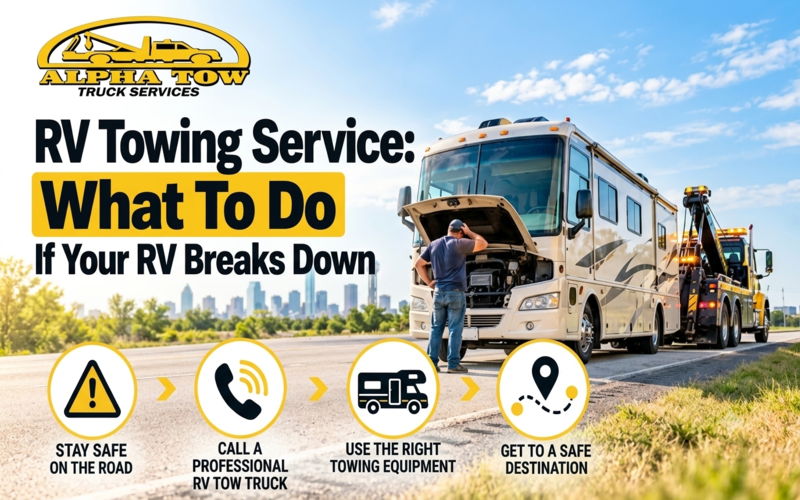
An RV breakdown isn’t simply a bigger version of a car breakdown.
A motorhome can be dramatically longer, taller, and heavier than a passenger vehicle. Travel trailers bring their own hitch, axle, and weight-distribution considerations. Add roadside conditions, limited clearance, and the possibility of mechanical damage, and sending an ordinary light-duty tow truck may not solve the problem.
It could create another one.
That’s why RV towing requires equipment matched to the specific recreational vehicle and breakdown situation.
Here’s what makes RV recovery different—and why giving the towing dispatcher the right information matters.
Why Can’t Every Tow Truck Tow an RV?
Tow trucks have operating limits just like the vehicles they recover.
A truck designed primarily for passenger cars and small SUVs may not have the capacity, wheel-lift configuration, wheelbase clearance, or recovery equipment necessary for a large motorhome.
RVs also vary enormously.
“RV” could describe a relatively compact camper or a large Class A motorhome with dimensions and weight closer to a bus.
That means dispatch can’t determine the correct towing equipment from the word “RV” alone.
What Makes RV Towing Different?
| RV Challenge | Why It Matters During Towing |
| Greater weight | Towing equipment must have sufficient rated capacity |
| Long wheelbase | Turning and hookup geometry become more important |
| Low clearance | Steps, tanks, plumbing and bodywork may be vulnerable |
| Greater height | Routes may require clearance awareness |
| Long rear overhang | Incorrect lifting can create clearance problems |
| Different drivetrains | Towing method must suit the vehicle configuration |
| Trailer configuration | Requires correct hitch and trailer-handling equipment |
| Breakdown damage | Disabled wheels, axles or suspension can complicate recovery |
These factors are why dispatch should identify the exact RV before sending a truck.
1. RVs Can Exceed Light-Duty Towing Capacity
Weight is one of the clearest differences.
Large motorhomes contain far more than an engine and passenger compartment. They may include water tanks, generators, appliances, furniture, batteries, storage, and substantial living-space construction.
All of that contributes to the vehicle’s operating weight.
A tow truck must have adequate capacity not simply to pull the RV forward, but to lift, control, secure, and safely transport it according to the chosen towing method.
Using equipment that isn’t appropriately rated can create unsafe handling and place excessive stress on both vehicles.
Alpha’s DFW RV towing operation specifically describes using RV-rated carriers and equipment suited to larger motorhomes, campers, and trailers. Alpha Tow Truck Services
2. Motorhome Length Changes Towing Geometry
Weight isn’t the only concern.
A large RV can have a long wheelbase and substantial bodywork extending beyond the rear axle.
That rear overhang matters when one end of the motorhome is lifted.
The towing operator has to consider whether parts of the RV could contact the road when:
- Entering a driveway
- Crossing a dip
- Climbing an incline
- Turning
- Moving over uneven pavement
An approach that works perfectly well for a passenger car may provide insufficient clearance for a large motorhome.
3. RVs Have Vulnerable Components Underneath
Look underneath many RVs and you’ll find considerably more than a simple vehicle floor.
Depending on the model, there may be:
- Holding tanks
- Plumbing
- Steps
- Exhaust components
- Leveling equipment
- Generator components
- Storage compartments
- Electrical systems
- Body panels
This makes hookup and clearance particularly important.
Improper lifting or positioning can potentially damage components that weren’t involved in the original breakdown.
The objective of professional RV towing isn’t merely to move the vehicle—it is to avoid turning one mechanical problem into several.
4. The Drivetrain Affects the Towing Method
RV configurations differ.
Some motorhomes have different axle and drivetrain arrangements, while towable RVs don’t have their own propulsion system at all.
The towing operator needs to know what they’re working with before moving the vehicle.
Depending on the RV and situation, preparation can involve considerations relating to the driveshaft, transmission, axle, brakes, steering, or other components.
This is another reason why accurate vehicle identification is so important when calling for help.
5. RV Height Matters During Transport
An RV’s height doesn’t disappear when it gets attached to towing equipment.
In some configurations, lifting part of the vehicle can change its effective height or angle.
That makes route planning more important around:
- Low bridges
- Parking structures
- Tree limbs
- Utility infrastructure
- Low-clearance entrances
- Service-facility access points
A route that works for a normal tow truck carrying a sedan may not necessarily be appropriate for a large motorhome.
6. Travel Trailers Create a Different Towing Problem
Not every RV has an engine.
If a travel trailer loses its tow vehicle or suffers a roadside problem, the towing company must deal with the trailer’s own hitch, axle arrangement, braking system, weight, and condition.
For dispatch, “my RV broke down” therefore isn’t enough information.
Is it a Class A motorhome?
Class C?
Travel trailer?
Fifth wheel?
Camper?
And what exactly failed?
Alpha Tow Truck Services’ RV service specifically covers both motorhomes and RV trailers that have lost their tow vehicle. Alpha Tow Truck Services
7. A Breakdown Can Change the Equipment Required
Two identical motorhomes may require different recovery approaches depending on what failed.
Consider the difference between:
Engine failure: The RV is disabled but may still roll normally.
Flat or damaged tire: Wheel condition becomes relevant.
Suspension failure: Normal towing or loading may be more complicated.
Axle problem: The vehicle may not roll safely.
Off-road or soft-ground situation: Recovery may be needed before towing.
Collision damage: Body, steering, wheels, and suspension may all be affected.
That’s why a good dispatcher asks what happened rather than simply asking where you are.
What Equipment May Be Used for RV Towing?
The exact setup depends on the RV and situation, but specialized towing operations may use heavy-duty wreckers, appropriately rated carriers, wheel-lift or underlift systems, winching/recovery equipment, and other tools appropriate to the vehicle.
There isn’t one universal “RV tow truck.”
The correct equipment depends on:
RV type + dimensions + weight + drivetrain + damage + location.
That’s the combination the towing company needs to understand.
What Information Should You Give the RV Towing Dispatcher?
This is one of the easiest ways an RV owner can improve the towing process.
Before calling, gather as much of the following information as possible:
- RV class or type
- Make and model
- Approximate length
- Approximate weight if known
- Number of axles
- Breakdown type
- Whether the RV rolls
- Tire or wheel damage
- Current location
- Road or campground access
- Intended destination
If you’re uncertain about a specification, don’t guess.
Tell the dispatcher what you know. Photos may also help when the towing provider accepts them.
Sending detailed information increases the likelihood that appropriately rated equipment arrives the first time.
What Happens When an RV Breaks Down on a DFW Highway?
A motorhome breakdown on I-35E or I-635 presents a very different situation from one occurring inside a campground.
On a busy DFW highway, visibility and traffic exposure become immediate concerns.
Turn on hazard lights and move as far from active traffic as the disabled vehicle can safely go. If the RV cannot be moved or is creating an immediate traffic hazard, emergency authorities may need to be contacted.
When requesting towing, give dispatch your:
Highway
Direction of travel
Nearest exit
RV type
Nature of the breakdown
These details help reduce confusion when sending specialized equipment.
What About RV Breakdowns at Campgrounds?
Campgrounds create different challenges.
Roads can be narrow. Trees may reduce overhead clearance. Parked vehicles can restrict turning space. Soft shoulders and tight campsites can make positioning a large recovery vehicle difficult.
Tell dispatch if the RV is:
- Inside a campsite
- On gravel or grass
- Behind a gate
- Under low trees
- On a narrow campground road
- Surrounded by other vehicles
The towing operator needs enough space not only to reach the RV but also to position the recovery vehicle safely.
Can Roadside Assistance Fix the RV Without Towing It?
Sometimes.
A breakdown doesn’t automatically mean the entire RV needs to be transported.
Certain situations may be resolved through roadside assistance depending on the problem and available equipment.
However, mechanical failures involving the engine, drivetrain, suspension, axle, or other major systems may require towing to an appropriate repair facility.
The key question is not:
“Can I make the RV move?”
It is:
“Can this RV safely continue the trip?”
If the answer is uncertain, professional evaluation is preferable to risking further damage.
Why the Right Equipment Can Prevent Additional Damage
Suppose the original problem is an engine failure.
That’s one repair.
If incorrect towing also damages bodywork, plumbing, the drivetrain, or underside components, the breakdown has suddenly become much more expensive.
Correct towing equipment helps manage:
- Vehicle weight
- Lift points
- Ground clearance
- Towing stability
- Drivetrain requirements
- Vehicle dimensions
- Securement
In other words, specialized RV towing isn’t an unnecessary upgrade.
For many larger recreational vehicles, it’s part of moving them correctly.
Specialized RV Towing Across Dallas-Fort Worth
When requesting an RV tow, the most useful question isn’t simply “How quickly can a truck arrive?”
Ask:
“Are you sending equipment appropriate for my RV?”
Alpha Tow Truck Services provides dedicated RV towing across Dallas-Fort Worth. Its current RV service covers motorhomes and travel trailers and uses RV-rated equipment for breakdowns, recovery, and transport to repair facilities or other destinations. Alpha Tow Truck Services
Its service area includes Dallas, Plano, Garland, Irving, Rowlett, Mesquite, McKinney, Richardson, and surrounding DFW areas. Alpha Tow Truck Services
Conclusion
RVs need specialized towing equipment because they’re not simply oversized cars.
Their weight, dimensions, wheelbase, ground clearance, drivetrain, rear overhang, and onboard components create towing challenges that ordinary passenger vehicles don’t present.
The breakdown itself adds another variable.
An RV with engine trouble may require one setup, while an RV with axle damage or one stranded on soft ground may need something completely different.
When calling for RV towing, provide accurate vehicle and breakdown information and make sure the company is prepared to send appropriately rated equipment.
The right tow isn’t just about getting your RV moving again.
It’s about getting it to the next destination without adding damage along the way.
Frequently Asked Questions
Can a regular tow truck tow an RV?
Not every tow truck can safely handle every RV. Large motorhomes may require equipment with greater lifting, towing, and recovery capacity.
What type of tow truck is needed for a motorhome?
It depends on the motorhome’s size, weight, configuration, condition, and breakdown. Larger RVs commonly require heavy-duty or RV-rated towing equipment.
Why does an RV’s weight matter when towing?
The tow truck and recovery equipment must be rated to safely lift, control, and transport the vehicle. RV weight can substantially exceed that of normal passenger vehicles.
Can a towing company move a travel trailer without its tow vehicle?
Some specialized towing providers can. Alpha’s RV towing service specifically includes RV trailers that have lost their tow vehicle. Alpha Tow Truck Services
What information should I provide when calling for RV towing?
Provide the RV type, make and model, approximate size and weight if known, number of axles, breakdown type, whether it rolls, exact location, and intended destination.
Can an RV be towed from a campground?
Yes, when suitable equipment can safely access and recover it. Tell dispatch about narrow roads, gates, soft ground, low trees, or other access restrictions before the truck arrives.
Does Alpha Tow Truck Services provide RV towing in DFW?
Yes. Alpha provides dedicated RV towing for motorhomes, campers, and RV trailers across its Dallas-Fort Worth coverage area. Alpha Tow Truck Services
Why shouldn’t I use the nearest standard tow truck for a large RV?
The closest truck may not have the required capacity or configuration. Sending the correct RV-rated equipment is more important than simply sending whichever truck happens to be nearest.