
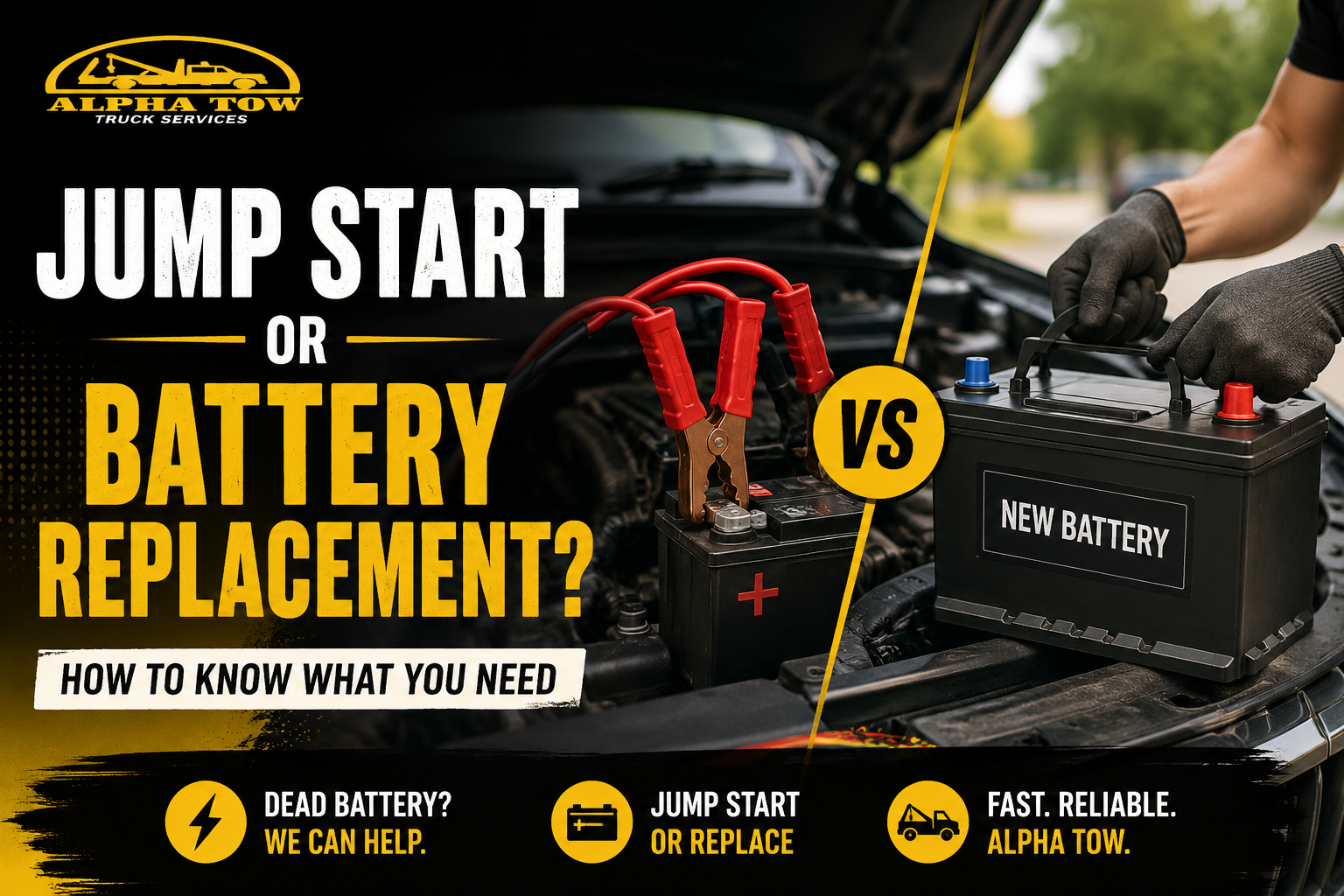
You turn the key, and instead of your engine firing up, you get a single click — or nothing at all. Before you panic or start Googling “jump start near me,” it helps to know something most drivers don’t: a jump start and a battery replacement solve two completely different problems, and picking the wrong one can leave you stranded again within days.
This guide walks through exactly how to tell which one you actually need, what happens during each service, and how to avoid paying for a jump start today only to be right back on the phone next week.
If your battery is under three years old, was drained by something obvious like headlights left on, and starts reliably after a jump, a jump start is all you need. If your battery is three or more years old, needed a jump more than once recently, cranks slowly even after being jumped, or dies again shortly after starting, it’s time for a battery replacement rather than another temporary fix.
What a Jump Start Actually Does?
A jump start uses another vehicle’s battery or a portable jump box to send a burst of current into your dead battery, giving it just enough charge to turn the starter motor and get the engine running. Once your engine is running, the alternator takes over and continues charging the battery as you drive.
Here’s the part most drivers don’t realize: a jump start doesn’t fix anything. It doesn’t repair a failing battery, and it doesn’t address whatever caused the battery to die in the first place. It’s a temporary boost — nothing more. Whether that boost is enough depends entirely on why your battery went dead.
When a Jump Start Is the Right Call
A jump start is usually all you need in these situations:
- You accidentally left your headlights, interior lights, or a device plugged in overnight
- Your battery is less than three years old with no prior starting issues
- Extreme cold temporarily reduced your battery’s cranking power
- The car starts immediately after the jump and continues starting normally afterward
- This is the first time you’ve needed a jump in recent memory
If your situation matches these signs and your car starts up strong and keeps starting over the following days, your battery was simply drained, not damaged. No further action needed beyond making sure lights and accessories are switched off when you park.
Warning Signs You Need a Battery Replacement, Not Another Jump
A jump start becomes a losing game when the battery itself is the problem, not just a drained charge. Watch for these signs:
- Your battery is three or more years old — most car batteries only last three to five years
- You’ve needed more than one jump start in the past month
- The engine cranks slowly even right after being jumped and driven
- The car dies again shortly after the jump, especially at idle or stoplights
- You see corrosion — a chalky white or blue buildup — around the battery terminals
- The battery case looks swollen, bloated, or cracked
- There’s a rotten-egg smell coming from under the hood
- A battery or charging system warning light is on your dashboard
Any one of these on its own is worth paying attention to. Two or more together are a strong sign that a jump start will only buy you a few more days before you’re stranded again — often somewhere far less convenient than your driveway.
Jump Start vs. Alternator Problem: How to Tell the Difference
This is where a lot of drivers get confused, because a failing alternator can look exactly like a dead battery. The key difference is what happens after the jump.
If your car starts after a jump and continues running fine over the following days, the battery was simply drained — a one-time event, not an ongoing problem.
If your car starts after a jump but then dies again while you’re driving, or your headlights and dashboard lights dim and brighten as you accelerate and slow down, the alternator is likely failing to recharge the battery while you drive. In that case, replacing the battery alone won’t solve the problem — the charging system needs to be inspected as well. A qualified technician can test both in a matter of minutes.
What Happens During a Professional Jump Start Service
A roadside battery jump start service typically takes 10 to 15 minutes from arrival. A technician connects a jump box or service vehicle to your battery terminals in the correct sequence, allows a short charging period for deeply drained batteries, and confirms your engine starts and holds a stable idle before disconnecting.
A good technician doesn’t just jump your car and leave. They’ll typically test your battery’s voltage and overall health on the spot, so you know immediately whether you’re dealing with a one-time drain or a battery that’s on its way out — instead of finding out the hard way a few days later.
What Happens During a Battery Replacement
If testing confirms the battery itself has failed, a replacement is a straightforward process: the old battery is disconnected and removed, terminals and the battery tray are cleaned of any corrosion, a new battery matched to your vehicle’s specifications is installed and properly secured, and the connections are tested to confirm a stable charge before you’re back on the road.
A properly matched replacement battery restores reliable starting power and removes the guesswork of wondering whether your car will start each morning.
How to Avoid Getting Stranded Again
- Note your battery’s age — check the sticker on the case for the manufacture date
- If it’s past the three-year mark, ask for a battery health test at your next service visit
- Keep terminals clean and free of corrosion
- Avoid leaving lights, chargers, or accessories on when the engine isn’t running
- If you’ve needed more than one jump recently, treat it as a warning, not a coincidence
FAQs: Jump Start vs. Battery Replacement
Q. How do I know if I need a jump start or a new battery?
A. If your battery is under three years old and starts reliably after one jump, a jump start is enough. If it’s older, needed repeated jumps, or dies again shortly after starting, you likely need a replacement.
Q. Can a jump start damage my car?
A. When done correctly, a jump start is safe. Incorrect cable sequencing or connecting to a swollen or frozen battery can cause damage, which is why a trained roadside technician is the safer choice over guesswork.
Q. How long does a car battery usually last?
A. Most car batteries last three to five years, though extreme heat, extreme cold, and short trips that don’t fully recharge the battery can shorten that lifespan.
Q. Why does my car die again shortly after being jumped?
A. This is a common sign of either a battery that can no longer hold a charge or a failing alternator that isn’t recharging the battery while you drive. Both should be tested before you get back on the road.
Q. Is it cheaper to keep jump starting my car instead of replacing the battery?
A. It may seem that way short term, but a failing battery typically keeps dying at increasingly inconvenient times, and repeated deep discharges can shorten the life of a replacement battery down the line. Addressing it early is usually the more reliable and cost-effective choice.
The Bottom Line
A dead battery isn’t always a battery replacement, and it isn’t always “just” a jump start either. The real answer comes down to your battery’s age, how it behaves after being jumped, and whether this is a one-time inconvenience or a repeating pattern. Paying attention to those signs is what keeps a five-minute roadside fix from turning into a surprise breakdown next week.
If your car won’t start anywhere in the Dallas–Fort Worth area, Alpha Tow Truck Services provides fast roadside battery jump start service, and can test your battery on the spot to tell you honestly whether a jump is enough or a replacement is the smarter call — so you’re not left guessing.