
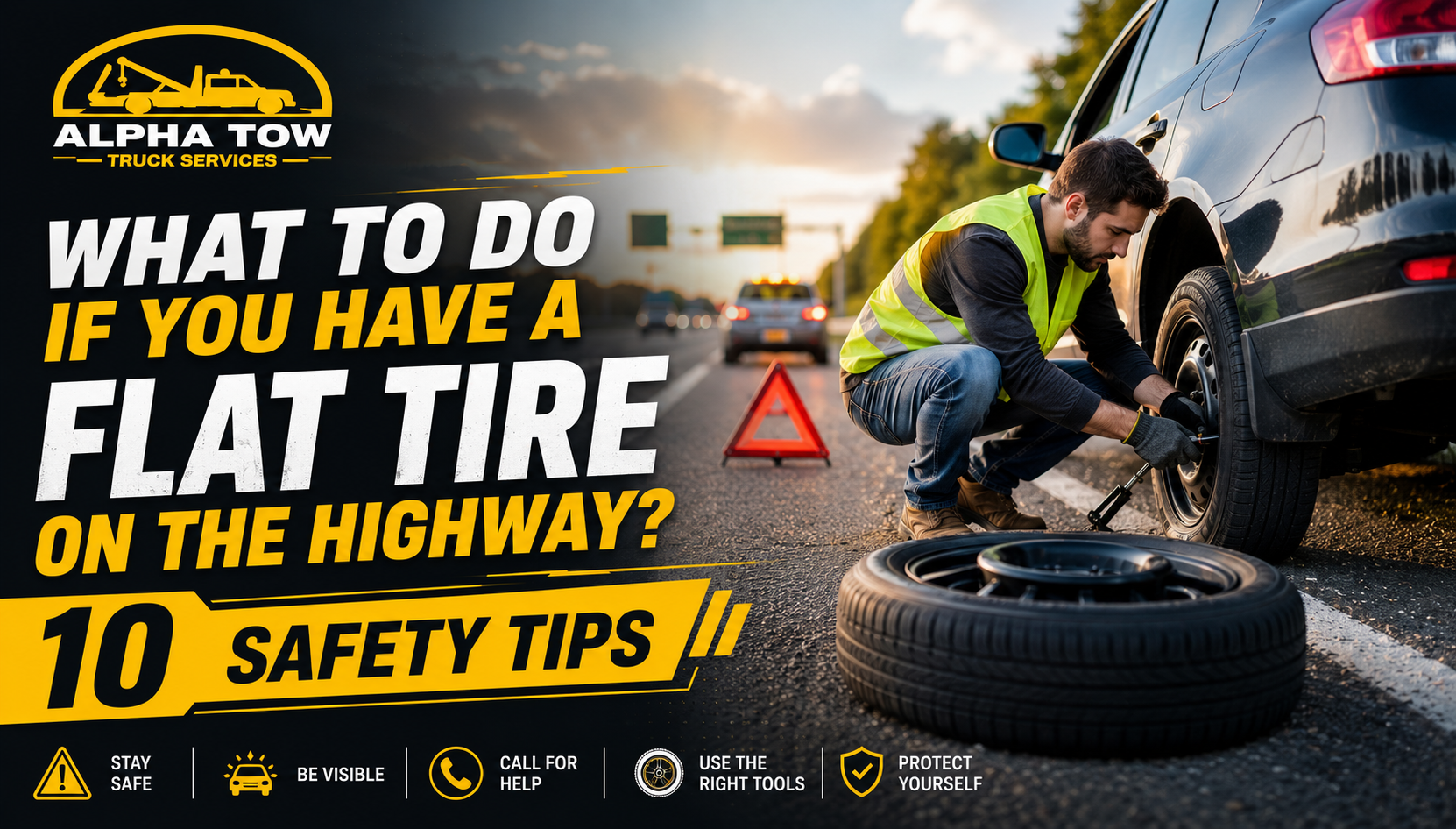
A flat tire is frustrating anywhere, but a flat tire on a highway can become dangerous very quickly. Fast-moving traffic, limited shoulder space, poor visibility, and passing vehicles all create additional risks.
If you experience a flat while driving, your first priority should be getting yourself and your passengers to a safer position, not immediately changing the tire.
Knowing what to do before a highway tire emergency happens can help you make better decisions when you’re under pressure.
What Should You Do With a Flat Tire on the Highway?
If you get a flat tire on the highway, stay calm, slow down gradually, and avoid sudden braking or steering. If possible, move the vehicle to the far-right shoulder or another safe location away from traffic. Turn on your hazard lights and keep your seat belt fastened. If the vehicle is in a dangerous position, don’t attempt to change the tire yourself. Contact roadside assistance or a professional tire service and follow their instructions while waiting in a safe location.
Your exact response depends on where the vehicle stops and how safely you can get away from moving traffic.
1. Keep Control of the Vehicle
The first few seconds after a tire fails are important.
You may feel the vehicle pull to one side, vibrate, become difficult to steer, or make a loud flapping or thumping sound.
Don’t panic or slam on the brakes.
Instead:
- Keep both hands on the steering wheel.
- Maintain control of the vehicle.
- Gradually reduce your speed.
- Avoid sudden steering movements.
- Look for a safe place to move away from traffic.
A blown tire can affect handling, so abrupt movements can make the situation worse.
If the vehicle remains controllable, focus on moving toward a safer location rather than stopping immediately in an active traffic lane.
2. Move as Far Away From Traffic as Possible
If there is a usable shoulder, gradually move the vehicle toward it.
Try to position the vehicle as far from moving traffic as reasonably possible while maintaining control.
However, don’t make a dangerous maneuver just to reach a particular stopping location.
If you’re unable to safely move the vehicle, keep your hazard lights on and contact emergency or roadside assistance for guidance.
Your goal is to create as much distance as possible between yourself and moving traffic.
3. Turn on Your Hazard Lights
Once you’ve stopped, turn on your hazard lights.
They alert approaching drivers that your vehicle is disabled and may help increase your visibility, particularly in poor weather, at night, or on busy roads.
If your vehicle has additional emergency warning equipment, use it only when you can do so safely.
You should never put yourself in the path of traffic simply to place a warning device farther from the vehicle.
4. Stay Inside the Vehicle if It’s Safer
Many drivers assume they should immediately get out and stand beside the car.
That isn’t always the safest choice.
If your vehicle is on a narrow shoulder with fast-moving traffic immediately beside it, remaining inside with your seat belt fastened may be safer than standing outside.
Assess your surroundings before opening the door.
If you can safely move away from traffic and reach a protected area, follow the guidance of local authorities or roadside assistance.
The safest option depends heavily on the road, traffic conditions, vehicle position, weather, and surrounding environment.
5. Don’t Attempt a Tire Change in a Dangerous Location
Changing a tire sounds straightforward when you’re parked in a driveway.
On a highway shoulder, it’s a different situation.
You may be working only a few feet from vehicles traveling at highway speeds.
Even an experienced driver can be struck by a passing vehicle if traffic moves unexpectedly toward the shoulder.
Don’t attempt to change the tire yourself if:
- The shoulder is extremely narrow.
- Traffic is moving very close to your vehicle.
- Visibility is poor.
- It’s dark and you don’t have adequate visibility.
- Weather conditions are dangerous.
- Your vehicle is in an unstable position.
- You don’t have the proper equipment.
- You’re uncomfortable working beside highway traffic.
In these circumstances, calling roadside assistance is usually the safer decision.
6. Contact Roadside Assistance
If the vehicle cannot safely continue, professional roadside assistance can help determine the appropriate next step.
Depending on the situation, assistance may include:
- Tire changes
- Tire inflation
- Tire repair where appropriate
- Tire replacement
- Vehicle towing
- Emergency roadside support
When you call, explain that you’re on a highway and provide your exact location.
If possible, give the provider:
- Highway or interstate number
- Direction of travel
- Nearest exit
- Mile marker
- Nearby landmark
- Vehicle make and model
- Description of the tire problem
- Number of passengers
- Whether the vehicle is safely off the roadway
The more precise your location, the easier it can be for the service provider to find you.
7. Use Your Phone’s Location Information
If you’re unsure where you are, don’t guess.
Your smartphone may provide your current location through its maps application or location-sharing features.
Look for information such as:
- Highway number
- Direction
- Exit number
- Mile marker
- Nearby road
- Cross street
- GPS location
Providing accurate location information is particularly important on long stretches of interstate where several roads may look similar.
If you’re speaking with a roadside provider, stay available by phone in case the driver needs additional information.
8. Don’t Stand Behind or Directly in Front of the Vehicle
If you have to exit the vehicle, pay close attention to where you stand.
Never position yourself where a passing vehicle could strike you or where you could be trapped between your vehicle and traffic.
Avoid standing directly behind the disabled vehicle on a highway shoulder.
Drivers can drift onto shoulders, especially when they’re distracted, tired, or dealing with poor weather.
If you can safely move to a protected location away from traffic, do so.
9. Be Careful in Bad Weather
Rain, snow, fog, and strong winds can make a highway tire emergency considerably more dangerous.
Visibility can decrease while stopping distances increase.
In bad weather:
- Keep hazard lights activated.
- Remain aware of passing traffic.
- Avoid unnecessary movement around the vehicle.
- Don’t attempt repairs if conditions are unsafe.
- Tell roadside assistance about the weather and your exact location.
If visibility is extremely poor, staying inside the vehicle with your seat belt fastened may be safer than standing outside.
10. What If You Have a Spare Tire?
Having a spare tire doesn’t automatically mean you should change it yourself.
First consider your location.
A spare tire can be useful when you’re safely parked somewhere away from traffic, but changing a tire beside a busy interstate can expose you to unnecessary risk.
If you are safely away from traffic and have the correct equipment, you may be able to follow the vehicle manufacturer’s instructions for changing the tire.
However, if you’re on a dangerous highway shoulder, professional assistance is often the better option.
What Causes Flat Tires on Highways?
Flat tires can happen for many reasons.
Common causes include:
- Punctures from nails or other road debris
- Tire underinflation
- Tire damage
- Worn tread
- Valve problems
- Road hazards
- Tire age
- Excessive heat
- Overloading
Sometimes a tire failure occurs without much warning.
That is why regular tire inspections and proper inflation are important, particularly before long highway trips.
How Can You Prevent a Highway Flat Tire?
You can’t eliminate every risk, but basic tire maintenance can reduce the chance of a preventable failure.
Before a long trip, check:
Tire Pressure
Use the vehicle manufacturer’s recommended tire pressure rather than relying on how the tire looks.
Driving with incorrect tire pressure can affect handling, tire wear, and fuel economy.
Tread and Tire Condition
Look for excessive wear, cuts, cracks, bulges, or other visible damage.
If a tire looks damaged, have it evaluated before taking a long trip.
Spare Tire
Know whether your vehicle has a spare, temporary spare, or tire repair kit.
Check that the equipment is actually present and usable.
Tire Age
Tires can deteriorate over time even when they have not accumulated significant mileage.
Follow the tire manufacturer’s recommendations and have older tires inspected for signs of deterioration.
What Should You Keep in Your Vehicle for a Tire Emergency?
A basic emergency kit can make an unexpected roadside problem easier to manage.
Consider carrying:
- Tire pressure gauge
- Vehicle owner’s manual
- Properly inflated spare tire, if equipped
- Jack and lug wrench, if applicable
- Phone charger or power bank
- Flashlight
- Reflective safety equipment
- Basic emergency supplies
However, equipment doesn’t eliminate the danger of working beside highway traffic.
The safest response is still to avoid unnecessary exposure to moving vehicles.
When Should You Call a Tow Truck Instead?
A flat tire doesn’t always require a tow.
If the tire can be safely changed or serviced where the vehicle is located, roadside assistance may be enough.
However, towing may be appropriate when:
- The vehicle has more than one damaged tire.
- The wheel is damaged.
- The vehicle cannot be safely moved.
- The tire problem caused additional damage.
- You don’t have a usable spare.
- The vehicle is in a dangerous position.
- The vehicle has another mechanical problem.
- A replacement tire isn’t immediately available.
A roadside professional can help determine whether tire service or towing is the more appropriate solution.
What Should You Never Do With a Highway Flat Tire?
Some mistakes can turn a simple tire problem into a serious safety incident.
Avoid:
- Stopping in a travel lane unless absolutely unavoidable.
- Making sudden steering movements.
- Slamming on the brakes.
- Standing close to moving traffic.
- Walking into traffic to ask another driver for help.
- Attempting a tire change on an extremely narrow shoulder.
- Crawling underneath a vehicle on the roadside.
- Ignoring a damaged tire and continuing to drive.
- Leaving children or pets exposed to highway traffic.
- Using a damaged or incorrectly sized spare.
When in doubt, prioritize getting away from traffic and contacting professional assistance.
Frequently Asked Questions
Q. Can I drive a short distance on a flat tire?
A. It’s generally not advisable to continue driving on a completely flat or severely damaged tire. Driving on it can damage the wheel and potentially create additional safety problems. Move to a safe location if possible and arrange assistance.
Q. Should I stay in my car after a highway tire blowout?
A. If your vehicle is safely away from traffic, staying inside with your seat belt fastened may be safer than standing beside the vehicle. If the vehicle is in a dangerous location, follow the instructions of emergency personnel or roadside assistance.
Q. Can roadside assistance change a flat tire on the highway?
A. Yes, roadside assistance providers may offer tire-changing services. Whether the tire can be changed at the location depends on the vehicle, tire damage, equipment, and safety of the roadside location.
Q. What if I don’t have a spare tire?
A. If your vehicle doesn’t have a usable spare, contact roadside assistance. Depending on the damage and location, a provider may be able to repair or replace the tire, or arrange a tow if necessary.
Q. How do I know where I am on the highway?
A. Check your phone’s maps application, nearby exit signs, mile markers, or highway signs. Give the roadside provider the highway number, direction of travel, nearest exit, and mile marker whenever possible.
Q. Is it safe to change a tire on the highway shoulder?
A. Not always. A narrow shoulder, fast-moving traffic, darkness, poor visibility, or bad weather can make changing a tire extremely dangerous. If you cannot create a safe working area away from traffic, call professional roadside assistance.
Q. What should I do if my tire blows out while driving?
A. Keep control of the steering wheel, avoid sudden braking or steering, gradually reduce speed, and move toward a safe location when possible. Once stopped, activate your hazard lights and contact roadside assistance if the vehicle cannot safely continue.
Final Takeaway
A flat tire on the highway is more than a mechanical inconvenience. The biggest danger is often the traffic around the disabled vehicle.
Keep control of the vehicle, move as far away from traffic as safely possible, activate your hazard lights, and avoid unnecessary exposure to passing vehicles. Don’t feel pressured to change the tire yourself simply because you have a spare and a jack.
If the location is dangerous or you aren’t equipped to handle the problem safely, roadside assistance is often the better choice. A few extra minutes waiting for professional help can be far safer than risking injury beside a busy highway.