Towing Tips & Roadside Assistance Blog in Texas

Live Dispatch — Call Now
⏱️ LESS THAN 30 MIN ARRIVAL 📞 (214) 225-6493 🟢 LIVE 24/7 ALPHA TOWING SERVICE
flat tire on the highway

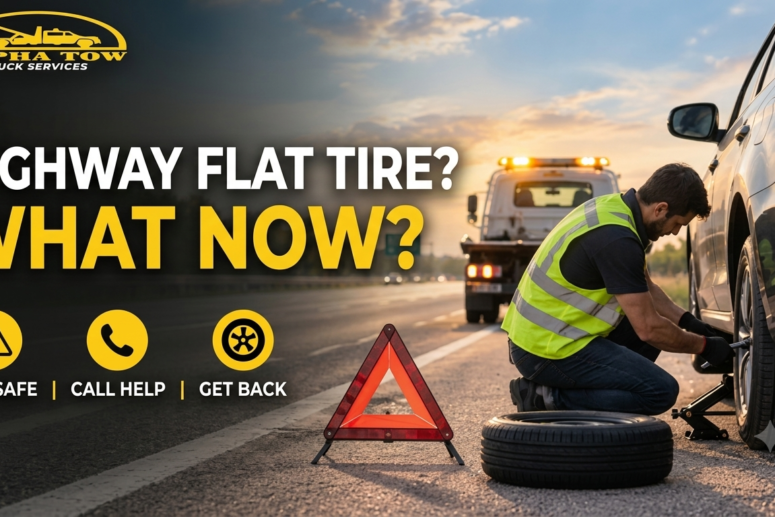
What to Do If You Get a Flat Tire on the Highway


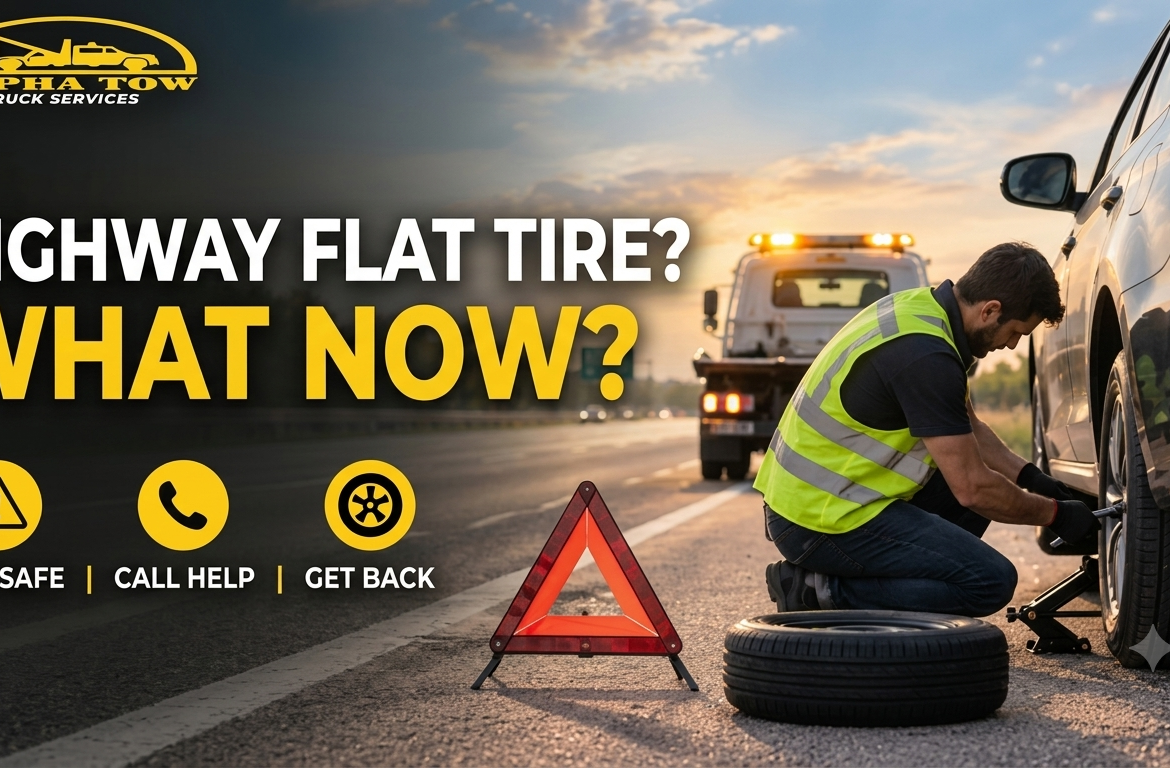
A flat tire on the highway can become dangerous within seconds. Between fast-moving traffic, narrow shoulders, poor visibility, and passing vehicles, trying to change a tire in the wrong location can put you at serious risk.

If you feel a sudden vibration, hear a flapping sound, or notice that your vehicle is pulling to one side, stay calm and focus on getting to a safe position. If the tire is completely flat or damaged, do not continue driving farther than necessary to reach a safe location.

The safest option may be to pull over, turn on your hazard lights, and call a professional flat tire change service.

Alpha Tow Truck Services provides roadside assistance for drivers who need help with flat tires, including situations where changing the tire yourself is unsafe or your vehicle does not have a usable spare.

What Should You Do Immediately After Getting a Flat Tire?

Your first priority is not changing the tire. It is getting yourself and your vehicle out of danger.

Follow these steps if you experience a flat tire on the highway.

  1. Stay Calm and Reduce Your Speed

    A sudden tire failure can cause your vehicle to pull, shake, or become difficult to control. Avoid making a sudden turn or slamming on the brakes.

    Gradually reduce your speed while keeping both hands on the steering wheel. Try to maintain control and move toward the shoulder or another safe area when possible.

    If the tire is losing air but the vehicle remains controllable, do not accelerate to reach your destination. Driving on a severely damaged tire can damage the wheel and create additional safety risks.

  2. Move as Far Away From Traffic as Possible

    If you can safely reach the shoulder, move your vehicle as far away from moving traffic as practical.

    The ideal location is a wide, stable shoulder where there is enough space between your vehicle and passing traffic. If you cannot reach a safe shoulder without putting yourself at greater risk, stop in the safest location available.

    Do not stop in a travel lane unless there is absolutely no alternative.

  3. Turn On Your Hazard Lights

    Once stopped, activate your hazard lights to make your vehicle more visible to approaching drivers.

    This is especially important at night, during rain, in heavy traffic, or in areas where visibility is limited.

    If you have warning triangles or other emergency equipment and can place them without entering a dangerous area, use them according to the manufacturer’s instructions. Never put yourself in the path of traffic just to make your vehicle more visible.

  4. Do Not Stand Beside the Vehicle If It Is Unsafe

    A common mistake is immediately getting out and inspecting the tire.

    On a busy highway, standing next to your vehicle can expose you to passing traffic. A vehicle on the shoulder can still be struck by another driver who moves over unexpectedly or loses control.

    If your location is unsafe, remain inside the vehicle with your seat belt fastened when appropriate and wait for professional assistance.

Should You Change the Tire Yourself?

Changing a tire yourself may be reasonable in a safe parking area or wide, protected location. A highway shoulder is a completely different situation.

Before attempting a tire change, consider:

  • Is the shoulder wide enough to work safely?
  • Is traffic moving quickly beside you?
  • Is the ground level and stable?
  • Is visibility good?
  • Do you have a working spare tire?
  • Do you have the correct jack and lug wrench?
  • Can you safely access the tire?
  • Are weather conditions suitable?
  • Are you comfortable changing the tire?

If the answer to any of these questions creates doubt, calling a professional is usually the better choice.

A roadside flat tire service can help you avoid spending unnecessary time beside moving traffic while trying to perform a repair yourself.

When You Should Call a Flat Tire Change Service

You do not need to attempt a tire change just because you have a spare tire in your trunk.

Professional roadside assistance can be especially useful when:

You Are Stopped on a Busy Highway

Highway traffic creates a much greater risk than changing a tire in a driveway or parking lot.

If vehicles are passing close to your shoulder, call a professional flat tire change service instead of attempting the repair yourself.

You Don’t Have a Spare Tire

Many modern vehicles do not come with a traditional spare. Some use tire repair kits or run-flat tires instead.

If you do not have a usable spare, you may need professional roadside assistance or a mobile tire service to get you moving again.

Your Spare Tire Is Flat or Missing

A spare tire is only useful if it is properly inflated and in usable condition.

If your spare is flat, damaged, missing, or unsuitable for your vehicle, changing it is not an option. Professional tire assistance may be able to provide another solution or arrange transportation for your vehicle.

The Tire or Wheel Is Severely Damaged

A simple puncture is different from a destroyed tire.

If the tire has separated, the sidewall is severely damaged, the wheel is bent, or you have driven on the flat long enough to damage the tire, a standard tire change may not solve the problem.

In that situation, you may need a mobile tire service or towing to a tire shop.

You Are Driving a Larger Vehicle

Changing a tire on a larger vehicle can require heavier equipment and additional precautions.

If you are dealing with a commercial vehicle, truck, trailer, or another heavy vehicle, do not assume that the standard jack and spare-tire procedure applies.

Professional roadside assistance can help determine what equipment and service are appropriate.

What Is a Mobile Tire Service?

A mobile tire service brings tire assistance directly to your location instead of requiring you to drive to a tire shop.

This can be particularly convenient when you are stranded on the roadside and cannot safely drive the vehicle.

Depending on the situation and available equipment, mobile tire assistance may involve replacing a damaged tire, installing a spare, or helping determine the safest next step when the tire cannot be repaired at the roadside.

The biggest advantage is convenience: you do not have to risk driving on a damaged tire or arrange transportation to get help.

What Is an Emergency Tire Change?

An emergency tire change is roadside tire assistance provided when you need immediate help because a tire failure has left you stranded.

This can happen during the day, at night, during bad weather, or while traveling through an unfamiliar area.

The key difference is the urgency and location. You are not simply changing a tire at home—you are dealing with an unexpected tire problem while away from a safe repair location.

When requesting an emergency tire change, give the dispatcher:

  • Your exact location
  • The direction you are traveling
  • Highway or road name
  • Nearest exit or landmark
  • Vehicle make and model
  • Tire size if known
  • Whether you have a spare
  • Whether the tire or wheel has visible damage
  • Whether you are safely parked on the shoulder

Accurate information helps the towing company determine what assistance may be required.

Why You Shouldn’t Drive on a Flat Tire

It can be tempting to drive slowly to the next exit or gas station after getting a flat.

However, driving on a completely flat tire can cause additional damage to the tire and wheel. It can also affect steering and vehicle stability.

Even if the distance appears short, there is no guarantee that the vehicle will remain controllable.

A tire that initially has a simple puncture can become severely damaged after being driven without adequate air pressure. What could have been a tire replacement may turn into a damaged wheel or a towing situation.

If the tire is flat and you are unsure whether the vehicle can safely move, stop and request roadside assistance.

What If You Have a Tire Blowout?

A blowout requires even more caution.

If a tire suddenly fails while you are traveling at highway speed:

  • Keep both hands on the steering wheel.
  • Avoid sudden braking.
  • Gradually release the accelerator.
  • Keep the vehicle moving straight.
  • Reduce speed in a controlled manner.
  • Move toward a safe shoulder when possible.
  • Turn on your hazard lights once stopped.
  • Get professional assistance if the vehicle cannot safely continue.
  • Do not immediately attempt to inspect the damaged tire while standing beside the highway.

A blowout can leave tire debris around the vehicle and may also cause damage to the wheel, suspension, or body.

Flat Tire vs. Tire Damage: Why It Matters

Not every tire problem can be solved with a simple tire change.

A professional roadside technician needs to consider the condition of the tire, wheel, spare, and vehicle before determining the best solution.

For example:

Situation Possible Solution
Tire has lost air but is otherwise usable Tire repair or inflation, when appropriate
Usable spare is available Spare tire installation
No spare tire Mobile tire assistance or towing
Damaged sidewall Tire replacement
Bent or damaged wheel Mobile assistance or towing
Multiple damaged tires Mobile tire service or towing
Vehicle cannot safely move Emergency roadside assistance or towing

A professional assessment can prevent you from attempting a repair that is not safe or appropriate.

How a Roadside Flat Tire Service Helps

Calling professional roadside assistance can make a stressful highway breakdown much easier to manage.

Instead of standing beside traffic with a jack and lug wrench, you can contact a towing company and provide your location and vehicle information. The dispatcher can determine what type of assistance may be appropriate.

A professional roadside flat tire service can be especially valuable when:

  • You are traveling alone.
  • You are stranded at night.
  • Weather conditions are poor.
  • Traffic is heavy.
  • You are unfamiliar with the area.
  • Your vehicle does not have a spare.
  • You cannot safely operate a jack.
  • The tire or wheel appears seriously damaged.

The goal is not simply to replace the tire. It is to get you safely back on the road or determine the safest way to move the vehicle.

What Information Should You Have Ready When Calling?

When you call for a flat tire change service, having the right information can help speed up dispatch.

Tell the dispatcher:

Where you are:

Give the highway, direction of travel, nearest exit, mile marker, or recognizable landmark.

What happened:

Explain whether you have a slow leak, completely flat tire, blowout, or visible wheel damage.

What vehicle you have:

Provide the make, model, and approximate size or type of vehicle.

Whether you have a spare:

Let the dispatcher know if you have a spare tire and whether you know if it is properly inflated.

Your safety situation:

Explain whether you are on a wide shoulder, narrow shoulder, travel lane, parking area, or another location.

This information helps the dispatcher understand the urgency and determine the appropriate roadside solution.

How to Stay Safe While Waiting for Tire Assistance

Once help has been requested, avoid unnecessary activity around the vehicle.

Keep your hazard lights on and stay aware of traffic. If your location is unsafe, remain inside the vehicle when appropriate rather than standing on the shoulder.

Do not attempt to flag down passing motorists or walk along the highway looking for help.

If you are in an especially dangerous position, communicate that clearly to the dispatcher so the responding team understands the situation.

If there is an accident, injury, fire, or immediate danger, contact emergency services first.

Need a Flat Tire Change in Dallas-Fort Worth?

A flat tire on the highway is not just an inconvenience. It can quickly become a safety issue when you’re stopped near fast-moving traffic.

If you can safely change the tire in a protected location and have the necessary equipment, replacing the tire may get you moving again. But when the shoulder is narrow, traffic is heavy, visibility is poor, the tire is badly damaged, or you do not have a usable spare, professional assistance is the safer choice.

Alpha Tow Truck Services provides roadside assistance for drivers who need help with tire problems throughout the Dallas-Fort Worth area. Whether you need a flat tire change service, roadside flat tire service, mobile tire service, or an emergency tire change, calling a professional can save time while reducing the risks of working beside highway traffic.

If you’re stranded with a flat tire, call Alpha Tow Truck Services at (214) 225-6493 for roadside assistance and help getting your vehicle safely moving again.


Frequently Asked Questions

1. What should I do if I get a flat tire on the highway?

Slow down gradually, maintain control, move to a safe shoulder if possible, turn on your hazard lights, and avoid standing near moving traffic. If the tire cannot be safely changed where you are, call a professional roadside flat tire service.

2. Can I drive on a flat tire to reach the next exit?

It is generally best not to drive on a completely flat tire. Doing so can damage the tire, wheel, and other components while making the vehicle harder to control. If you cannot safely continue, request a flat tire change service or towing assistance.

3. What if I don’t have a spare tire?

If your vehicle does not have a usable spare, contact a mobile tire service for roadside assistance. Depending on the tire’s condition and available equipment, a technician may be able to provide a suitable solution at your location or arrange towing.

4. How long does an emergency tire change take?

The time depends on your location, traffic, vehicle type, tire condition, and whether a usable spare is available. Providing your exact highway location and vehicle information can help the dispatcher send the appropriate assistance.

5. Should I change a flat tire myself on the highway?

Only consider changing the tire yourself if your vehicle is in a safe, stable location away from moving traffic and you have the correct equipment. On a narrow or busy highway shoulder, calling professional roadside assistance is usually the safer option.

6. What is included in a roadside flat tire service?

A roadside flat tire service may include assistance with installing a spare tire or addressing certain tire-related problems at your location. If the tire, wheel, or vehicle cannot be safely serviced roadside, towing or additional mobile tire assistance may be necessary.

7. What should I do after a tire blowout?

Keep control of the vehicle, avoid sudden braking or steering, gradually reduce your speed, and move to a safe location when possible. Once stopped, turn on your hazard lights and request an emergency tire change or roadside assistance.

8. Can Alpha Tow Truck Services help with flat tires?

Yes. Alpha Tow Truck Services provides roadside assistance for drivers dealing with flat tires and other roadside emergencies in the Dallas-Fort Worth area. Call (214) 225-6493 to request assistance.

Conclusion

A flat tire on the highway is more than an inconvenience—it can become a serious safety concern when you’re stopped beside fast-moving traffic. Your first priority should always be getting to a safe location rather than immediately attempting to change the tire.

If you have a usable spare and enough space to work safely, you may be able to replace the tire yourself. However, when traffic is heavy, the shoulder is narrow, visibility is poor, you don’t have a spare, or the tire and wheel are badly damaged, professional assistance is the safer and more convenient option.

Alpha Tow Truck Services provides flat tire change service, roadside flat tire service, mobile tire service, and emergency tire change assistance throughout the Dallas-Fort Worth area. If you’re stranded with a flat, call (214) 225-6493 and let the roadside team help you get back on the road safely.
Towing vs. Roadside Assistance

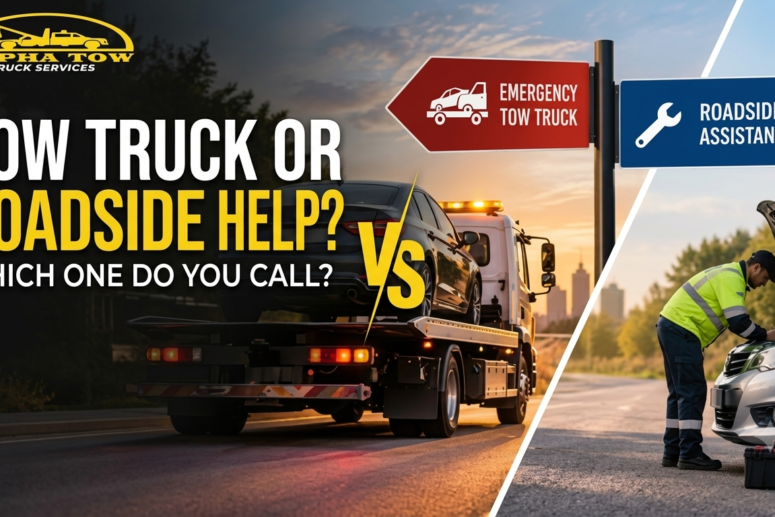
Towing vs. Roadside Assistance: When to Call Which Service


A vehicle problem does not always require a tow. Sometimes a jump start, tire change, fuel delivery, or lockout service can get you safely back on the road. But when your vehicle cannot be driven safely, continuing to wait for a roadside fix can create unnecessary risks.

That is where knowing the difference between roadside assistance vs. towing becomes important.

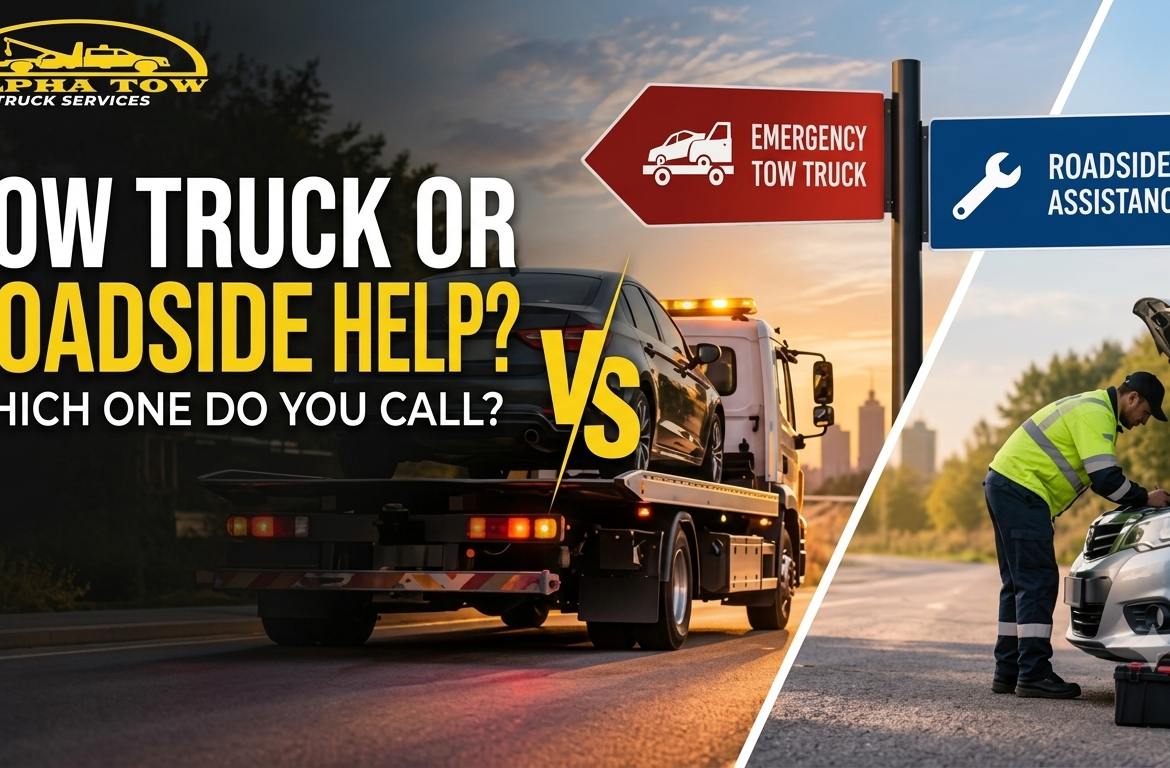
Roadside assistance is generally intended to resolve smaller problems at the location, while an emergency towing service is needed when the vehicle must be transported somewhere else. For example, a dead battery may only require a jump start, but a vehicle with major engine damage, accident damage, or a serious mechanical failure may need an emergency tow truck.

Knowing which service to request can help you get the right equipment faster, stay safer while stranded, and avoid wasting time on a repair that cannot solve the problem.

Roadside Assistance vs. Towing: What’s the Difference?

Roadside assistance is designed to address problems that may be resolved where your vehicle is located. Common examples include:

  • Dead battery or jump-start needs
  • Flat tire changes
  • Running out of fuel
  • Vehicle lockouts
  • Minor mechanical problems
  • Other situations where the vehicle may become operational again on-site

Towing is different because the vehicle needs to be transported. If it cannot be safely driven or a roadside technician cannot make it operational, towing becomes the practical next step. Roadside assistance programs commonly include towing as one possible service when a vehicle cannot safely continue driving.

The simplest way to think about it is:

If the problem can reasonably be fixed where you are, roadside assistance may be enough. If the vehicle needs to be moved because it cannot safely drive, call for towing.

When Should You Call an Emergency Tow Truck?

The biggest factor is safety. If driving the vehicle could put you, your passengers, or other motorists at risk, do not attempt to continue the trip simply because you are close to your destination.

Here are some situations when an emergency tow service is usually the better choice.

  1. Your Vehicle Cannot Be Safely Driven

    A vehicle that starts does not necessarily mean it is safe to drive.

    You may have a serious steering problem, brake issue, overheating engine, transmission failure, damaged suspension, or another mechanical problem that makes continued driving dangerous. Attempting to limp the vehicle to a repair shop could turn a manageable breakdown into a much more expensive repair.

    If the vehicle is unsafe or undriveable, an emergency tow truck can transport it to a repair facility or another secure location.

  2. You Have Been Involved in an Accident

    After a collision, visible damage is not always the full story. Steering, suspension, wheels, brakes, electrical systems, and other components may be affected even when the vehicle appears driveable.

    If the vehicle has significant damage, is leaking fluids, has deployed airbags, or cannot be operated normally, towing may be safer than trying to drive away from the scene.

    An emergency towing service can help move the vehicle away from an unsafe location and transport it to a repair facility or other appropriate destination.

  3. You Break Down on a Highway

    A breakdown on a highway presents a different level of risk from a vehicle that stops in a driveway or parking lot.

    Fast-moving traffic, limited shoulder space, poor visibility, and nighttime conditions can make remaining beside the vehicle dangerous. If your vehicle cannot be repaired quickly and safely where it sits, getting it removed from the roadway may be the safest option.

    In these situations, response time matters. A reliable emergency tow service should be able to collect information about your location, vehicle, and situation so the appropriate truck can be dispatched.

  4. A Roadside Repair Cannot Solve the Problem

    Sometimes you call roadside assistance expecting a quick fix, only to discover that the problem is more serious.

    For example, a technician may determine that a battery cannot simply be jump-started, a tire cannot be safely changed, or a mechanical issue requires shop-level repair.

    Roadside assistance does not necessarily mean the vehicle will be fixed on-site. If the vehicle remains undriveable, towing may be the next step.

  5. Continuing to Drive Could Cause More Damage

    A warning light or unusual noise does not always mean you need an immediate tow. However, some symptoms should not be ignored.

    Stop driving and consider an emergency tow if you experience:

    • Severe engine overheating
    • Loss of braking ability
    • Steering problems
    • Major fluid leaks
    • Loud grinding or severe mechanical noises
    • Transmission failure
    • Significant collision damage
    • Smoke or burning smells
    • A wheel or suspension problem

    When you are unsure whether driving is safe, it is better to have the vehicle assessed than to risk additional damage or a roadside accident.

When Roadside Assistance Is the Better Choice

Not every roadside problem requires an emergency tow truck.

If your vehicle is safely positioned and the problem is relatively simple, roadside assistance may be faster and more convenient.

Dead Battery

If your engine will not start because of a dead battery, a jump-start service may get you moving without requiring a tow. Some roadside providers can also test or replace a battery at the vehicle’s location.

Flat Tire

A flat tire may only require a spare tire installation. If the vehicle has a usable spare and the wheel and tire are otherwise safe, an on-site tire change can get you back on the road.

If there is no spare, the tire or wheel is badly damaged, or the vehicle cannot be safely handled roadside, towing may become necessary.

Locked Keys in the Vehicle

A vehicle lockout usually does not require towing. A roadside technician or locksmith can often help you regain access without moving the vehicle.

Empty Fuel Tank

Running out of fuel is another situation where roadside assistance can be more convenient than towing. Fuel delivery can get you enough fuel to reach a nearby gas station and continue your trip.

Why Response Time Matters During an Emergency

When you are stranded, response time is more than a convenience issue. It can directly affect your safety.

Consider a vehicle stopped on the shoulder of a busy highway. The longer you remain exposed to passing traffic, the longer you are dealing with a potentially hazardous environment.

That is why choosing a towing company with an active dispatch operation can make a difference.

Alpha Tow Truck Services operates a live 24/7 dispatch system throughout the Dallas-Fort Worth area. The company states that emergency towing requests are handled by a live dispatcher and that standard vehicles generally have a 30–45 minute target response window, depending on location and traffic.

When requesting an emergency tow truck, provide your exact location, vehicle type, direction of travel if you are on a highway, and a short description of the problem. Accurate information helps dispatch determine what type of truck and equipment may be appropriate.

What Makes Emergency Towing More Convenient?

Calling the right service the first time can save you from unnecessary delays.

If you know that the vehicle cannot be safely driven, requesting towing immediately allows the dispatcher to focus on vehicle recovery rather than sending assistance that cannot resolve the underlying problem.

A good emergency towing process should include:

  1. A live point of contact so you can explain what happened.
  2. Accurate location information so the driver can find you.
  3. Vehicle details so the right equipment can be selected.
  4. A realistic ETA based on traffic and current availability.
  5. Clear pricing information before dispatch whenever possible.
  6. A safe destination such as a repair shop, home, dealership, or other appropriate location.

Alpha Tow Truck Services states that its dispatch team considers the vehicle’s type, size, weight, condition, and location when determining the appropriate towing solution.

What Should You Do While Waiting for an Emergency Tow?

Once you have requested an emergency tow service, focus on staying safe.

If you are on a highway and the vehicle can be moved safely, get as far away from moving traffic as practical. Turn on your hazard lights and remain aware of surrounding traffic.

If leaving the vehicle would put you at greater risk, stay inside with your seat belt fastened when appropriate. Avoid standing directly beside the vehicle or walking into traffic to inspect a problem.

At night or in poor weather, visibility becomes even more important. Follow the instructions provided by your dispatcher and avoid attempting repairs in a dangerous location.

If there is an immediate threat involving fire, serious injury, an active collision, or another dangerous situation, contact emergency services first.

Emergency Towing or Roadside Assistance? Use This Simple Rule

Still unsure which service you need?

Use this basic decision:

Can the vehicle safely continue driving after a roadside fix?

  • Yes: Roadside assistance may be the right choice.
  • No: Request an emergency tow.
  • Not sure: Explain the symptoms to the dispatcher and ask what service is appropriate.

For example, a dead battery with no other problems may need a jump start. A vehicle with a failed transmission may need towing. A flat tire with a usable spare may need a tire change, while a vehicle with a damaged wheel may need transportation.

The goal is not simply to get the fastest service. It is to get the right service for the situation.

Get Emergency Towing Help in Dallas-Fort Worth

A roadside breakdown can become stressful quickly, especially when you are dealing with traffic, nighttime conditions, an accident, or a vehicle that cannot move.

Knowing the difference between roadside assistance and towing helps you make a better decision. If the issue can be safely resolved where you are, roadside assistance may be all you need. If your vehicle is unsafe, seriously damaged, or unable to continue, an emergency tow service is the safer option.

Alpha Tow Truck Services provides 24/7 emergency towing across the Dallas-Fort Worth area, with live dispatch for breakdowns, accidents, and disabled vehicles.

If your vehicle cannot safely continue, call (214) 225-6493 to speak with a live dispatcher and request emergency towing assistance.


Final Thought

The choice between roadside assistance and an emergency tow truck ultimately comes down to safety, drivability, and the severity of the problem. A dead battery, flat tire, lockout, or empty fuel tank may be resolved with roadside assistance. But if your vehicle has major mechanical damage, accident damage, brake or steering problems, or cannot be driven safely, towing is usually the better option.

When you’re stranded in an unsafe location or dealing with a vehicle that cannot continue, don’t take unnecessary chances trying to drive it to a repair shop. Calling a reliable emergency towing service can help get your vehicle and passengers to a safer location while preventing additional damage.

With 24/7 availability and live dispatch, Alpha Tow Truck Services can help drivers throughout the Dallas-Fort Worth area determine the right towing solution for their situation. When you’re unsure whether you need roadside assistance or towing, explain the problem to the dispatcher so the appropriate service can be arranged.

Frequently Asked Questions

1. What is the difference between roadside assistance and towing?

Roadside assistance is generally intended to resolve minor vehicle problems at the location, such as a dead battery, flat tire, lockout, or empty fuel tank. Towing is used when a vehicle cannot be safely driven and needs to be transported to another location.

2. When should I call an emergency tow truck?

You should consider calling an emergency tow truck when your vehicle is undriveable, unsafe to operate, seriously damaged after an accident, experiencing a major mechanical failure, or stranded in a location where remaining on the roadway creates a safety risk.

3. Is emergency towing available 24/7?

Many towing companies offer 24/7 emergency towing because vehicle breakdowns and accidents can happen at any time. Alpha Tow Truck Services provides 24/7 emergency towing and live dispatch throughout the Dallas-Fort Worth area.

4. Can roadside assistance tow my vehicle?

Yes. Towing can be one of the services included with a roadside assistance plan or provided when an on-site repair cannot resolve the problem. If the vehicle remains undriveable after roadside assistance arrives, towing may be the next step.

5. Should I drive my vehicle if it is having mechanical problems?

Not if the problem makes the vehicle unsafe to operate. Severe overheating, brake problems, steering issues, major fluid leaks, significant collision damage, or unusual mechanical noises can indicate that driving could create additional risks or damage. In these situations, an emergency tow service may be the safer choice.

6. What information should I provide when requesting emergency towing?

Provide your exact location, vehicle make and model, vehicle condition, the type of problem you’re experiencing, and whether you’re on a highway, shoulder, parking lot, or another location. If you’ve been involved in an accident, tell the dispatcher about any visible damage and whether anyone is injured.

7. Is an emergency tow truck only for accidents?

No. Emergency towing can be needed for many situations besides accidents, including major breakdowns, engine or transmission failures, brake or steering problems, overheating, damaged tires or wheels, and vehicles that cannot safely continue driving.

8. How quickly can an emergency tow truck arrive?

Response times depend on your location, traffic, weather, current demand, and the type of vehicle involved. Providing an accurate location and vehicle information when you call can help the dispatcher send the appropriate tow truck as efficiently as possible.

9. What should I do while waiting for emergency towing?

Turn on your hazard lights and move the vehicle away from moving traffic if you can do so safely. Stay aware of surrounding traffic and avoid standing in dangerous areas around the vehicle. If there is an immediate threat such as a serious accident, fire, or injury, contact emergency services first.

10. How do I know whether I need roadside assistance or an emergency tow service?

Ask yourself whether the vehicle can safely continue driving after a simple roadside fix. If yes, roadside assistance may be appropriate. If the vehicle cannot safely move or requires significant mechanical repair, an emergency tow service is generally the better choice.

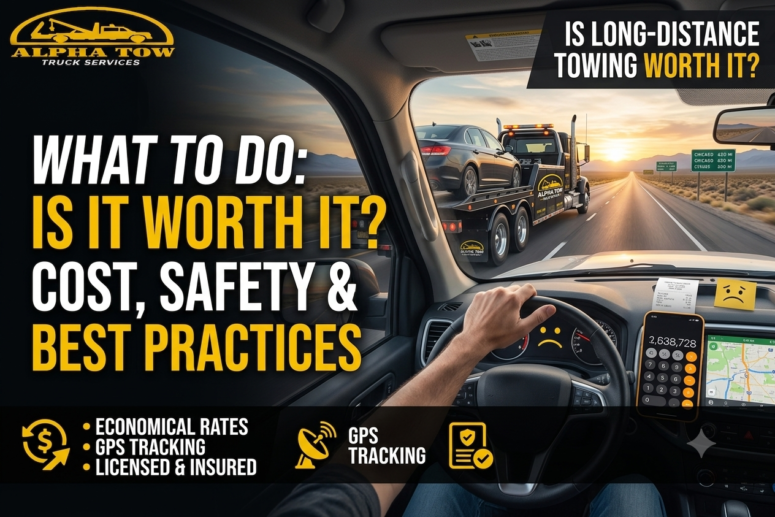
Is Long-Distance Towing Worth It? Cost, Safety & Best Practices

Is Long-Distance Towing Worth It? Cost, Safety & Best Practices

Moving a vehicle across the state, or across the country, isn’t the same decision as calling for a quick local tow. The cost is higher, the vehicle spends far more time in transit, and there’s a lot more that can go wrong if the wrong company or the wrong method is used. So the question drivers reasonably ask before committing is simple: is long-distance towing actually worth it?

This guide walks through what a long distance towing service actually involves, what it typically costs, how to evaluate safety and reliability before you book, and the best practices that separate a smooth transport from an expensive headache.

Long-distance towing is worth it when driving the vehicle yourself isn’t practical or safe — a non-running vehicle, a car you’re relocating without driving, an inherited or purchased vehicle from out of state, or a specialty vehicle you don’t want to put extra miles on. It typically costs more per mile than a local tow but less than the value of your time, fuel, wear, and risk of driving an unreliable vehicle long distance. The key to making it worth it is choosing a provider with flatbed equipment, transparent pricing, and verifiable insurance and licensing.

What Is Long-Distance Towing, Exactly?

Long-distance towing, sometimes called interstate towing or vehicle transport, moves a vehicle well beyond a typical local tow radius — often hundreds or thousands of miles, sometimes across multiple states.

Unlike a short local tow, this is almost always done using flatbed equipment, since keeping all four wheels off the road is essential to avoid the cumulative wear that comes from any wheels rolling over a long distance.

It’s commonly used for non-running vehicles being relocated, vehicles purchased or inherited out of state, classic and collector cars that shouldn’t accumulate extra highway miles, and situations where a breakdown happens far from home and driving the vehicle further simply isn’t safe.

What Does Long-Distance Towing Cost?

Pricing for a long distance tow is generally structured around a combination of a base dispatch fee and a per-mile rate, with the per-mile cost typically decreasing somewhat as distance increases. Vehicle type, weight, and condition all factor in — a non-running luxury SUV costs more to transport than a small operable sedan, both because of the equipment required and the added care involved.

A reputable long distance towing service will give you a clear, itemized quote before dispatch, not a vague estimate that changes once the truck arrives. If a company won’t commit to a number until your vehicle is already loaded, that’s a signal to look elsewhere.

Is It Actually Worth It? Weighing the Real Alternatives

Driving It Yourself

If the vehicle runs reliably, driving it yourself is typically the cheapest option on paper. But it comes with real costs that are easy to underestimate: your time, fuel, meals, potential lodging for a multi-day trip, added mileage and wear, and the risk of a breakdown along the way in an unfamiliar area.

Shipping Through a Broker

Vehicle shipping brokers can sometimes offer competitive rates by bundling your vehicle with others on an open or enclosed trailer, but this often means a less flexible pickup window and less direct communication with the actual driver handling your vehicle.

A Dedicated Long-Distance Towing Service

A direct, flatbed-equipped tow gives you a dedicated vehicle, a specific pickup and delivery window, and — critically — a vehicle that never touches the road during transport. For a non-running vehicle, an AWD car, or anything you don’t want accumulating extra miles, this is usually the safest and most predictable option, even at a somewhat higher price point.

How to Evaluate Safety Before You Book

  • Confirm the company uses flatbed equipment for long-distance moves, not a hook-and-chain or basic wheel-lift setup
  • Ask about insurance coverage for your vehicle during transit, and get it in writing
  • Verify licensing — a legitimate interstate towing operation should be able to confirm this without hesitation
  • Ask how the vehicle will be secured — proper strapping at multiple points, not just a single chain
  • Request a realistic transit timeline, including how far the truck typically travels per day

Best Practices Before You Request a Quote

  1. Document your vehicle’s condition

    Take clear photos of your vehicle from multiple angles, including any existing damage, before pickup. This protects you if any dispute arises about the vehicle’s condition at delivery.

  2. Remove personal belongings

    Most towing insurance policies only cover the vehicle itself, not personal items left inside. Clear out anything valuable or important before pickup.

  3. Get everything in writing

    A trustworthy long distance tow provider will confirm pricing, pickup and delivery windows, and insurance details in writing before your vehicle is ever loaded — not verbally promised and forgotten.

  4. Ask about drivetrain-specific handling

    If your vehicle is AWD or 4WD, confirm the provider is using flatbed transport specifically, since these vehicles can suffer drivetrain damage if towed any other way over long distances.

  5. Confirm communication during transit

    A reliable provider should be reachable for updates during a multi-day transport, not unreachable until the vehicle simply shows up.

What Makes a Long-Distance Towing Company Trustworthy

Trust in this industry comes down to a few concrete things you can actually verify, rather than taking a company’s word for it. Transparent, written pricing before dispatch is the first sign. Verifiable insurance coverage for your vehicle during transit is the second. A real answer to questions about equipment, licensing, and experience with your specific vehicle type is the third. And a company willing to walk you through the entire process before you commit — rather than rushing you toward a booking — is usually the clearest sign you’re dealing with a provider that has nothing to hide.

How Long-Distance Towing Works, Step by Step

Understanding the actual process makes it much easier to evaluate whether a provider is handling your vehicle correctly.

  1. You request a quote

    You provide pickup and delivery locations, vehicle details, and condition. A legitimate long distance towing service gives you an itemized quote based on this information, not a vague range.

  2. Pickup is scheduled and confirmed

    A specific pickup window is set, along with an estimated delivery window based on distance and the provider’s typical daily travel range.

  3. Vehicle inspection and documentation

    At pickup, the driver should document your vehicle’s condition, ideally with photos, and provide you with a copy. This protects both you and the company if any question arises at delivery.

  4. Flatbed loading and securing

    Your vehicle is loaded onto a flatbed platform and secured at multiple points with straps or chains rated for its weight. All four wheels stay off the road for the entire transport.

  5. Transit and communication

    For multi-day moves, a reliable provider stays reachable for status updates. You should know roughly where your vehicle is and when to expect delivery, rather than being left in the dark until it shows up.

  6. Delivery and final inspection

    At delivery, compare your vehicle’s condition against the pickup documentation before signing off, and address any concerns immediately rather than after the driver has left.

Common Mistakes to Avoid

  • Choosing based on price alone without confirming insurance coverage
  • Skipping photo documentation of your vehicle’s condition before pickup
  • Not asking whether your specific vehicle type requires flatbed transport
  • Leaving personal belongings inside the vehicle, assuming they’re covered
  • Accepting a verbal quote instead of getting pricing and terms in writing

FAQs: Long-Distance Towing

How much does long-distance towing typically cost per mile?

Per-mile rates vary by provider, vehicle type, and distance, generally decreasing somewhat for longer moves. Always request an itemized quote based on your specific vehicle and route rather than relying on a general estimate.

How long does a long-distance tow usually take?

Transit time depends on distance and the provider’s daily travel range, but a reputable company will give you a realistic window upfront based on your specific route.

Is my vehicle insured during long-distance transport?

It should be — always confirm coverage details and get them in writing before your vehicle is loaded, rather than assuming it’s automatically covered.

Should AWD or 4WD vehicles be towed differently for long distances?

Yes. These vehicles should always be flatbed transported for long-distance moves to avoid drivetrain damage from any wheels rolling over extended mileage.

What should I remove from my vehicle before a long-distance tow?

All personal belongings and valuables — most transit insurance only covers the vehicle itself, not items left inside it.

The Bottom Line

Long-distance towing is worth it in exactly the situations where driving isn’t practical or safe — a non-running vehicle, an out-of-state purchase, a specialty car you don’t want accumulating miles on, or simply a breakdown too far from home to reasonably continue. The real key to making it worth the cost is choosing a provider with transparent pricing, verifiable insurance, and flatbed equipment suited to your specific vehicle.

If you’re weighing a long-distance move for your vehicle, Alpha Tow Truck Services offers flatbed-equipped long distance towing with upfront, written pricing and verified insurance coverage — reach out anytime, 24/7, to talk through your specific situation before you request a final quote.

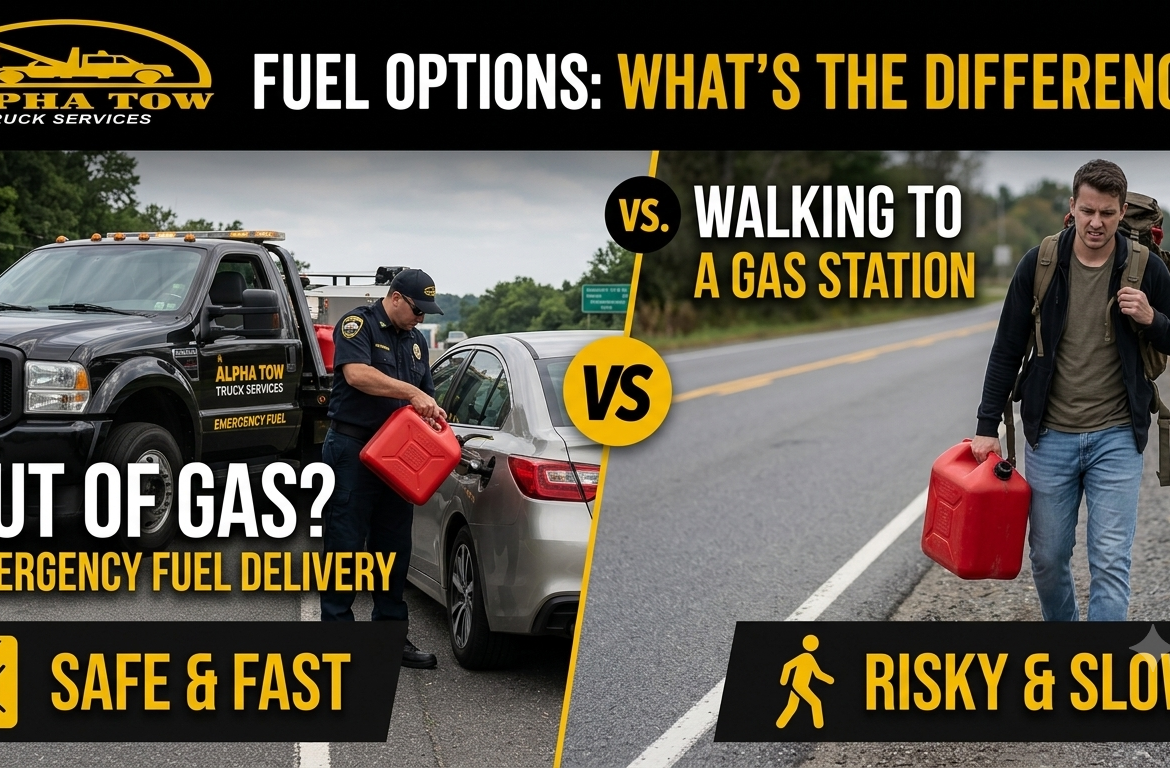
Out of Gas?

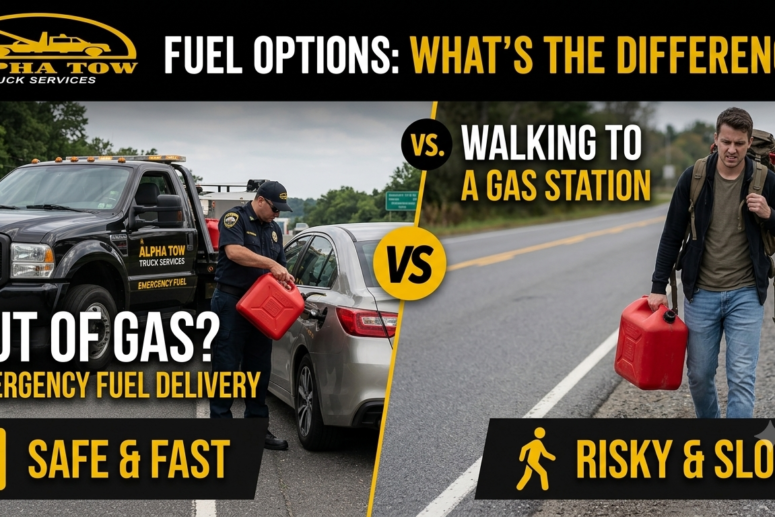
Out of Gas? Emergency Fuel Delivery vs Walking to a Gas Station


Emergency Fuel Delivery vs. Walking to a Gas Station: Which Is Safer?

Emergency fuel delivery is almost always the safer and faster option compared to walking to a gas station — especially on a highway shoulder, in bad weather, or after dark. A mobile fuel delivery technician brings gas or diesel directly to your vehicle, typically within 30 to 45 minutes, without you ever having to leave the relative safety of your car or walk along an active roadway.

Running out of gas is one of those breakdowns that feels almost embarrassing — no mechanical failure, no dramatic warning light, just an empty tank and a car that won’t move. The instinct for a lot of drivers is to just walk to the nearest gas station, grab a canister, and solve it themselves. It sounds simple. In practice, it’s often the riskier, slower, and more frustrating choice compared to calling an emergency fuel delivery service.

This guide breaks down exactly how the two options compare — safety, response time, and overall convenience — so you can make the smarter call the next time your tank hits empty in an inconvenient spot.

The Real Risks of Walking to a Gas Station

Walking for gas seems like the free, self-sufficient option, but it comes with risks that aren’t always obvious until you’re actually doing it.

Walking Along or Near Traffic

If your car ran out of gas on a highway shoulder, frontage road, or anywhere without a sidewalk, walking means sharing space with moving vehicles, often at highway speeds, often with limited visibility for drivers to see you. This is one of the most common ways stranded motorists get seriously injured, and it’s an entirely avoidable risk.

Leaving Your Vehicle and Belongings Unattended

Walking away means leaving your car, and everything in it, alone on the roadside — sometimes for 20 minutes or more each way. That’s a real consideration in an unfamiliar area, at night, or if you have valuables visible inside.

Distance and Physical Limitations

Not every breakdown happens conveniently close to a gas station. Depending on where you’re stranded, the nearest station might be a mile or several miles away — a serious problem in extreme Texas heat, in the rain, or if you’re not physically able to make that walk comfortably.

The Container Problem

Even after reaching a station, you still need a proper, safe gas container — not always something a station keeps in stock — plus the walk back carrying several pounds of fuel, followed by carefully transferring it into your tank roadside.

How Emergency Fuel Delivery Actually Works

A roadside fuel delivery service works far more simply than most drivers expect. You call, describe your location and vehicle, and specify whether you need gasoline or diesel fuel delivery. A technician is dispatched directly to you, arrives with proper fuel containers and safety equipment, and adds enough fuel to get you safely to the nearest station — no walking, no waiting outside your vehicle, no risk of misjudging distance in the heat.

The entire process typically takes less time than the walk alone would, and you never have to leave your car unattended or exposed to passing traffic.

Safety Comparison: Fuel Delivery vs. Walking

Walking exposes you to moving traffic, especially on shoulders and frontage roads with no pedestrian space. A mobile fuel delivery technician comes to you, so you can stay inside your locked vehicle the entire time.

Walking means leaving your car and belongings unattended for the full round trip. With roadside fuel service, your vehicle is never left alone — you’re right there when help arrives.

Walking in extreme heat, rain, or after dark adds real physical risk and reduced visibility. A fuel delivery service removes that risk entirely, since you’re not the one walking.

Response Time: What’s Actually Faster

It’s a common assumption that walking is the faster fix, but that’s rarely true once you account for the whole process. Walking to a station a mile away, waiting to buy a container and fuel, and walking back easily adds up to 40 minutes or more — often longer in heat or bad weather, and that’s before you’ve actually gotten the car running.

A dispatched emergency fuel delivery service typically reaches a stranded driver in the DFW area within 30 to 45 minutes, and once the technician arrives, refueling takes only a few minutes. In many cases, the total time from the first phone call to being back on the road is comparable to or faster than the walking route — without any of the added risk.

Convenience: Why Most Drivers Prefer Delivery

  • No need to locate a gas container, which many drivers simply don’t own
  • No carrying several pounds of fuel any distance on foot
  • No risk of spilling fuel on yourself or in your vehicle during a roadside transfer
  • Diesel fuel delivery available for drivers whose vehicles don’t run on standard gasoline — something a typical gas station canister purchase can’t necessarily solve if the station is out of diesel
  • You stay with your vehicle and belongings the entire time

When Walking Might Make Sense

There are limited situations where walking is genuinely reasonable — you’re in a safe, well-lit area with a proper sidewalk, the station is a short and clearly safe distance away, and you’re comfortable leaving your vehicle briefly. Even then, it’s worth weighing that convenience against simply calling for mobile fuel delivery and staying safely with your car the entire time.

What to Do the Moment You Run Out of Gas

  1. Coast to the safest available spot — a shoulder, parking lot, or side street, not a live lane
  2. Turn on your hazard lights immediately
  3. Stay inside your vehicle if you’re near moving traffic
  4. Call for emergency fuel delivery and provide your exact location and fuel type needed
  5. Avoid repeatedly trying to restart the engine, which can drain your battery unnecessarily

FAQs: Emergency Fuel Delivery

How much does emergency fuel delivery typically cost?

Pricing usually includes a service fee plus the cost of the fuel itself, confirmed upfront before dispatch so there are no surprises when the technician arrives.

Can I get diesel fuel delivery, or is it gas only?

Most mobile fuel delivery services carry both gasoline and diesel, so be sure to specify your vehicle’s fuel type when you call.

How much fuel does a delivery typically provide?

Enough to safely reach the nearest gas station and fill up properly — typically a few gallons, not a full tank.

Is it actually dangerous to walk on a highway shoulder for gas?

Yes. Highway shoulders see a meaningful number of secondary crashes involving pedestrians and stopped vehicles each year, which is exactly why staying with your car and calling for roadside fuel service is the safer choice.

How fast can a fuel delivery technician reach me?

In the DFW area, response times are typically 30 to 45 minutes depending on your location and current demand.

The Bottom Line

Running out of gas doesn’t have to mean a risky walk along a busy road or leaving your car unattended in an unfamiliar area. An emergency fuel delivery service brings the fuel to you — safely, quickly, and without the physical risk of walking in heat, rain, or low visibility.

If you’re stranded with an empty tank anywhere across Dallas-Fort Worth, Alpha Tow Truck Services offers fast, reliable mobile fuel delivery — gas or diesel — 24/7, so you can stay safe inside your vehicle while help comes directly to you.

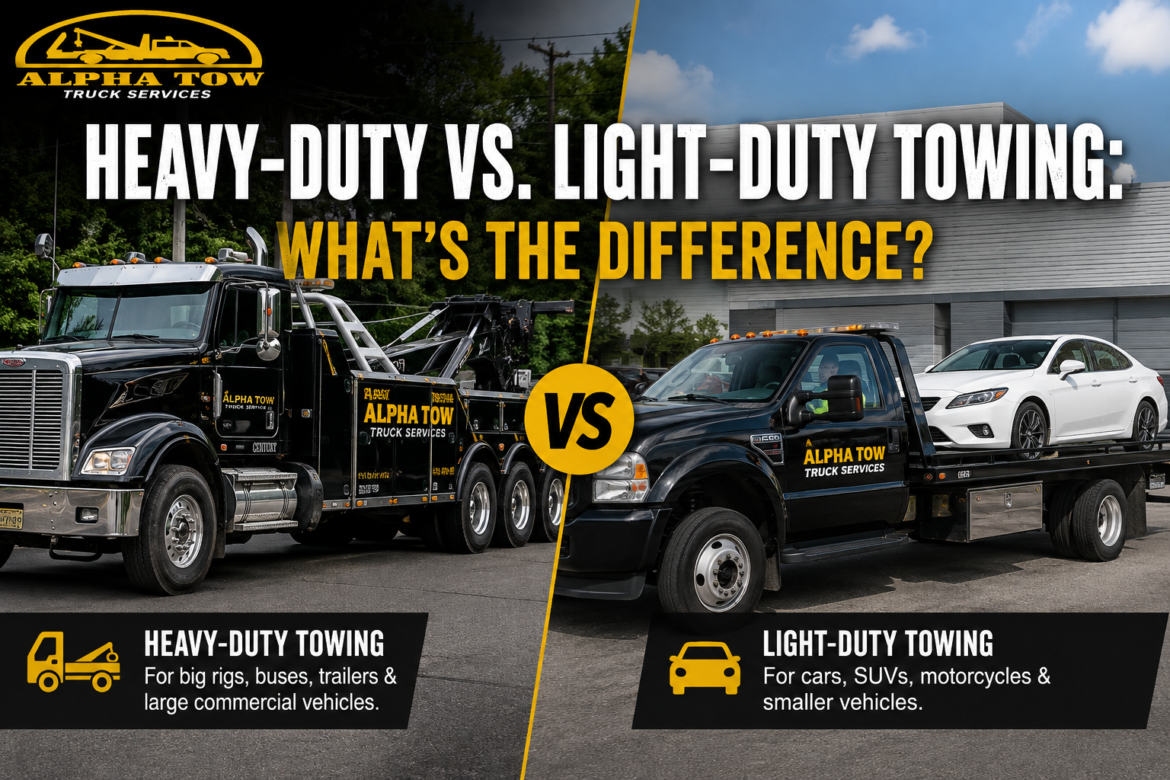
Heavy duty vs light duty

Heavy-Duty vs. Light-Duty Towing: How to Know Which You Need

When you call for a tow, most companies will ask one question before anything else: what are you driving? That’s not small talk, it determines which truck actually shows up. Sending a standard tow truck to move a loaded box truck is not just inefficient, it can be unsafe and can seriously damage the vehicle being towed.

This guide breaks down exactly what separates heavy-duty towing from light-duty towing, how companies decide which one your situation needs, and why getting it right the first time matters more than most drivers realize.

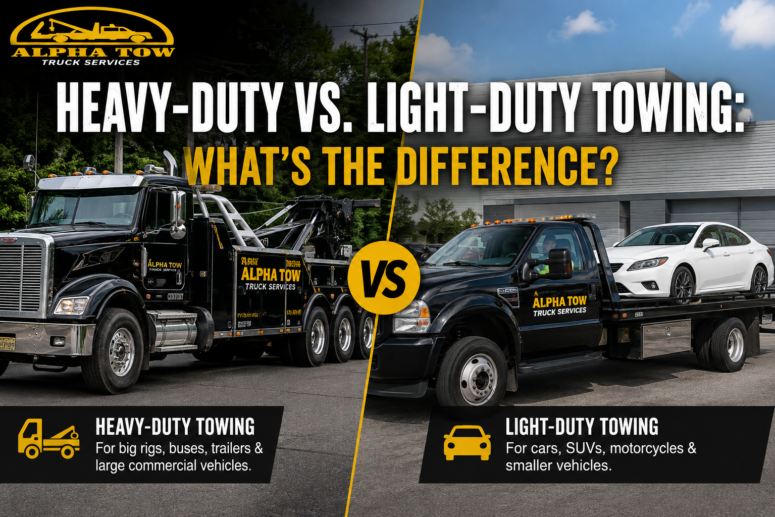
Light-duty towing handles standard passenger vehicles — cars, SUVs, minivans, and pickup trucks, generally under 10,000 pounds, using smaller, maneuverable tow trucks. 

Heavy-duty towing handles commercial and oversized vehicles like semi-trucks, buses, RVs, and loaded box trucks, generally over 26,000 pounds, using large wreckers with far greater lifting power, stronger frames, and specialized recovery equipment. The dividing line comes down to your vehicle’s weight, not just its size.

What Is Light-Duty Towing?

Light-duty towing covers the vehicles most drivers own and interact with daily: sedans, hatchbacks, SUVs, minivans, motorcycles, and standard pickup trucks. These vehicles generally fall under a Gross Vehicle Weight Rating (GVWR) of roughly 10,000 pounds, placing them in truck classes 1 and 2.

Light-duty tow trucks are built for speed, maneuverability, and everyday response. They typically use flatbed platforms or wheel-lift systems, and a single trained operator can safely handle the job without needing a commercial driver’s license. This is the type of tow truck you’ll see responding to highway breakdowns, dead batteries, flat tires, and fender-benders across Dallas–Fort Worth.


Common light-duty towing situations:

  • Sedan or SUV breakdown on the highway or in a parking lot
  • Accident recovery for a standard passenger vehicle
  • Flat tire with no usable spare
  • Dead battery requiring transport to a shop
  • Pickup trucks and minivans under roughly 10,000 lbs GVWR

What Is Heavy-Duty Towing?

Heavy-duty towing exists for vehicles that a standard tow truck simply cannot safely move. This includes semi-trucks, tractor-trailers, buses, RVs, garbage trucks, and other commercial vehicles typically weighing 26,000 pounds or more — classes 7 and 8 on the truck classification scale.

Heavy-duty tow trucks, often called wreckers, are built entirely differently from their light-duty counterparts. They’re equipped with high-capacity hydraulic booms — commonly rated around 25 tons — heavy-duty wheel lifts capable of handling several tons on their own, reinforced frames, air brake systems, and powerful winches for recovery situations like a jackknifed trailer or a vehicle that’s slid off the roadway.

Operating this equipment isn’t a routine skill. Heavy-duty towing typically requires a commercial driver’s license and specialized training, since the margin for error grows significantly when you’re recovering a fully loaded 40-foot trailer instead of a sedan.


Common heavy-duty towing situations:

  • Semi-truck or tractor-trailer breakdown or accident
  • Bus or RV recovery
  • Loaded commercial box trucks or delivery vehicles
  • Jackknifed trailers or vehicles requiring winch-out recovery
  • Construction equipment or oversized load transport 

Key Differences at a Glance

Weight capacity is the core distinction: light-duty trucks generally handle up to around 10,000 pounds, while heavy-duty trucks are built for 26,000 pounds and up — with medium-duty trucks bridging the gap in between for vehicles like box trucks and larger vans.

Equipment differs significantly as well. Light-duty trucks rely on flatbeds, wheel-lift systems, and standard hydraulics. Heavy-duty trucks use high-ton boom lifts, reinforced wheel lifts, air brake systems, and industrial-grade winches designed for recovery, not just transport.

Maneuverability favors light-duty trucks, which can navigate tight city streets, parking garages, and residential areas with ease. Heavy-duty trucks trade that agility for raw lifting power and stability, since their jobs typically happen on highways and open roads rather than tight urban spaces.

Licensing and training requirements are also different. Most light-duty tow operators don’t need a commercial driver’s license, while heavy-duty operators generally do, along with additional training specific to recovering large, loaded, or damaged commercial vehicles safely.

Cost reflects all of the above — heavy-duty towing typically costs more than light-duty towing, due to the specialized equipment, additional training, and complexity involved. That said, using a light-duty truck when a heavy-duty tow is actually required isn’t a way to save money; it usually leads to a failed attempt, wasted time, and potential damage to the vehicle.


Why Sending the Wrong Truck Is a Real Problem

It might seem like towing is towing, but mismatching the truck to the vehicle creates real risk. A light-duty truck attempting to lift a vehicle beyond its rated capacity can suffer equipment failure, and more importantly, can fail to properly secure a load it isn’t built for — creating a hazard on the road for everyone nearby.

On the other hand, dispatching a heavy-duty wrecker for a small passenger car isn’t dangerous, but it is inefficient and typically more expensive than necessary, since that size and equipment simply isn’t needed for the job.

This is exactly why a good towing company asks specific questions before dispatch, vehicle type, approximate weight, whether it’s loaded or empty, and the nature of the breakdown, rather than sending whichever truck happens to be closest.


How to Know Which Service You Need

  • If you’re driving a standard car, SUV, minivan, or pickup truck — light-duty towing is almost always the right call

  • If you’re driving or operating a semi-truck, bus, RV, or commercial vehicle over roughly 26,000 lbs — you need heavy-duty towing

  • If your vehicle is loaded with heavy cargo, even a mid-sized commercial vehicle may require medium- or heavy-duty equipment

  • If you’re unsure, tell the dispatcher your vehicle’s make, model, and whether it’s a personal or commercial vehicle — they’ll determine the right truck for you

FAQs: Heavy-Duty vs. Light-Duty Towing

Q. How do I know if I need heavy-duty or light-duty towing?
A. It comes down to your vehicle’s weight. Standard passenger vehicles under roughly 10,000 pounds need light-duty towing. Semi-trucks, buses, RVs, and loaded commercial vehicles over roughly 26,000 pounds need heavy-duty towing.

Q. Is heavy-duty towing more expensive than light-duty towing?
A. Generally, yes, due to the specialized equipment, additional operator training, and complexity of safely recovering larger vehicles.

Q. Can a light-duty tow truck tow a box truck or RV?
A. It depends on the specific vehicle’s weight. Smaller box trucks may fall into medium-duty range, while larger RVs and loaded box trucks typically require heavy-duty equipment. Always confirm your vehicle’s weight with the dispatcher.

Q. Do heavy-duty tow truck operators need special licensing?
A. Yes, in most cases. Operating heavy-duty recovery equipment typically requires a commercial driver’s license along with specialized training for handling large and loaded vehicles safely.

Q. What happens if the wrong type of tow truck is sent to my breakdown?
A. A truck that isn’t rated for your vehicle’s weight may be unable to safely lift or secure it, leading to delays, a second truck being dispatched, and in some cases, damage to your vehicle. Providing accurate vehicle details when you call helps avoid this entirely.


The Bottom Line

Heavy-duty and light-duty towing aren’t just different price tiers, they’re built around fundamentally different equipment, training, and vehicle weights. Knowing which one your situation calls for, and giving accurate details when you call, is what gets the right truck to you the first time.

Whether you’re stranded with a standard passenger vehicle or need a commercial truck safely recovered anywhere across Dallas–Fort Worth, Alpha Tow Truck Services dispatches the correctly equipped truck, light-duty or heavy-duty, based on your specific vehicle, so the job gets done safely and correctly the first time.


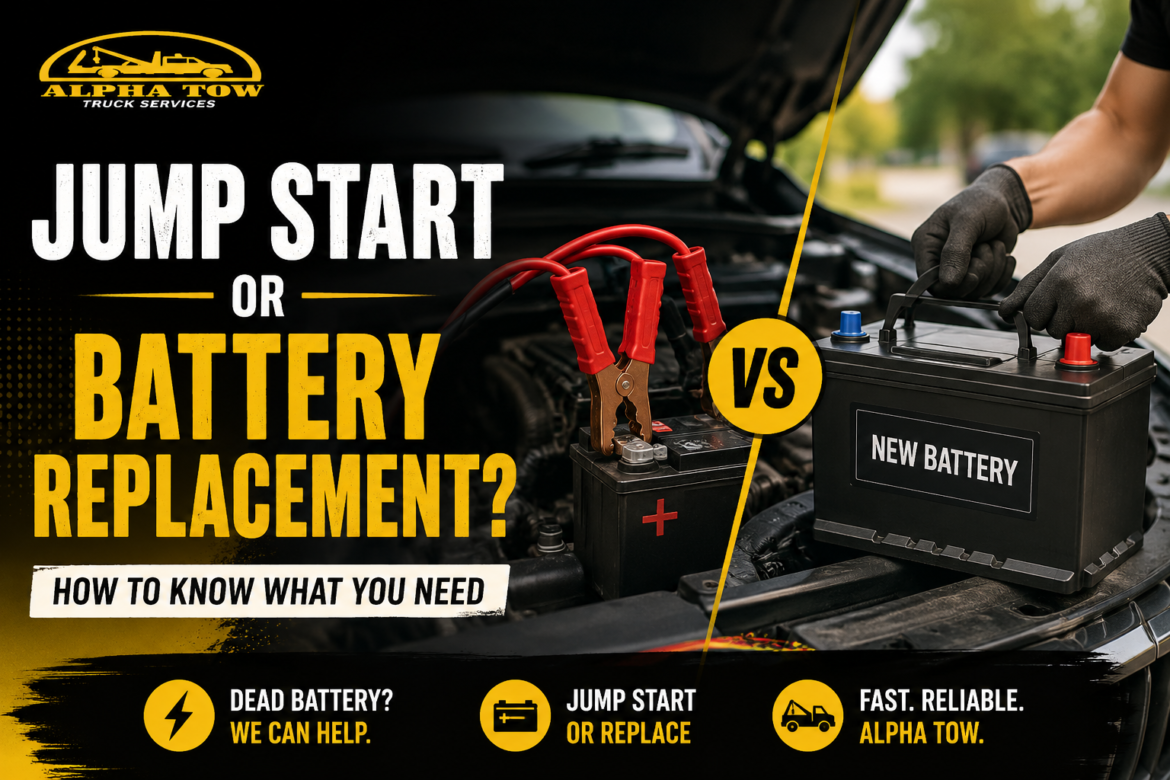
Jump start or battery replacement

Jump Start or Battery Replacement? How to Know What You Need

You turn the key, and instead of your engine firing up, you get a single click — or nothing at all. Before you panic or start Googling “jump start near me,” it helps to know something most drivers don’t: a jump start and a battery replacement solve two completely different problems, and picking the wrong one can leave you stranded again within days.

This guide walks through exactly how to tell which one you actually need, what happens during each service, and how to avoid paying for a jump start today only to be right back on the phone next week.

If your battery is under three years old, was drained by something obvious like headlights left on, and starts reliably after a jump, a jump start is all you need. If your battery is three or more years old, needed a jump more than once recently, cranks slowly even after being jumped, or dies again shortly after starting, it’s time for a battery replacement rather than another temporary fix.

What a Jump Start Actually Does?

A jump start uses another vehicle’s battery or a portable jump box to send a burst of current into your dead battery, giving it just enough charge to turn the starter motor and get the engine running. Once your engine is running, the alternator takes over and continues charging the battery as you drive.

Here’s the part most drivers don’t realize: a jump start doesn’t fix anything. It doesn’t repair a failing battery, and it doesn’t address whatever caused the battery to die in the first place. It’s a temporary boost — nothing more. Whether that boost is enough depends entirely on why your battery went dead.

When a Jump Start Is the Right Call

A jump start is usually all you need in these situations:

  • You accidentally left your headlights, interior lights, or a device plugged in overnight
  • Your battery is less than three years old with no prior starting issues
  • Extreme cold temporarily reduced your battery’s cranking power
  • The car starts immediately after the jump and continues starting normally afterward
  • This is the first time you’ve needed a jump in recent memory

If your situation matches these signs and your car starts up strong and keeps starting over the following days, your battery was simply drained, not damaged. No further action needed beyond making sure lights and accessories are switched off when you park.

Warning Signs You Need a Battery Replacement, Not Another Jump

A jump start becomes a losing game when the battery itself is the problem, not just a drained charge. Watch for these signs:

  • Your battery is three or more years old — most car batteries only last three to five years
  • You’ve needed more than one jump start in the past month
  • The engine cranks slowly even right after being jumped and driven
  • The car dies again shortly after the jump, especially at idle or stoplights
  • You see corrosion — a chalky white or blue buildup — around the battery terminals
  • The battery case looks swollen, bloated, or cracked
  • There’s a rotten-egg smell coming from under the hood
  • A battery or charging system warning light is on your dashboard

Any one of these on its own is worth paying attention to. Two or more together are a strong sign that a jump start will only buy you a few more days before you’re stranded again — often somewhere far less convenient than your driveway.

Jump Start vs. Alternator Problem: How to Tell the Difference

This is where a lot of drivers get confused, because a failing alternator can look exactly like a dead battery. The key difference is what happens after the jump.

If your car starts after a jump and continues running fine over the following days, the battery was simply drained — a one-time event, not an ongoing problem.

If your car starts after a jump but then dies again while you’re driving, or your headlights and dashboard lights dim and brighten as you accelerate and slow down, the alternator is likely failing to recharge the battery while you drive. In that case, replacing the battery alone won’t solve the problem — the charging system needs to be inspected as well. A qualified technician can test both in a matter of minutes.

What Happens During a Professional Jump Start Service

A roadside battery jump start service typically takes 10 to 15 minutes from arrival. A technician connects a jump box or service vehicle to your battery terminals in the correct sequence, allows a short charging period for deeply drained batteries, and confirms your engine starts and holds a stable idle before disconnecting.

A good technician doesn’t just jump your car and leave. They’ll typically test your battery’s voltage and overall health on the spot, so you know immediately whether you’re dealing with a one-time drain or a battery that’s on its way out — instead of finding out the hard way a few days later.

What Happens During a Battery Replacement

If testing confirms the battery itself has failed, a replacement is a straightforward process: the old battery is disconnected and removed, terminals and the battery tray are cleaned of any corrosion, a new battery matched to your vehicle’s specifications is installed and properly secured, and the connections are tested to confirm a stable charge before you’re back on the road.

A properly matched replacement battery restores reliable starting power and removes the guesswork of wondering whether your car will start each morning.

How to Avoid Getting Stranded Again

  • Note your battery’s age — check the sticker on the case for the manufacture date
  • If it’s past the three-year mark, ask for a battery health test at your next service visit
  • Keep terminals clean and free of corrosion
  • Avoid leaving lights, chargers, or accessories on when the engine isn’t running
  • If you’ve needed more than one jump recently, treat it as a warning, not a coincidence

FAQs: Jump Start vs. Battery Replacement

Q. How do I know if I need a jump start or a new battery?
A. If your battery is under three years old and starts reliably after one jump, a jump start is enough. If it’s older, needed repeated jumps, or dies again shortly after starting, you likely need a replacement.

Q. Can a jump start damage my car?
A. When done correctly, a jump start is safe. Incorrect cable sequencing or connecting to a swollen or frozen battery can cause damage, which is why a trained roadside technician is the safer choice over guesswork.

Q. How long does a car battery usually last?
A. Most car batteries last three to five years, though extreme heat, extreme cold, and short trips that don’t fully recharge the battery can shorten that lifespan.

Q. Why does my car die again shortly after being jumped?
A. This is a common sign of either a battery that can no longer hold a charge or a failing alternator that isn’t recharging the battery while you drive. Both should be tested before you get back on the road.

Q. Is it cheaper to keep jump starting my car instead of replacing the battery?
A. It may seem that way short term, but a failing battery typically keeps dying at increasingly inconvenient times, and repeated deep discharges can shorten the life of a replacement battery down the line. Addressing it early is usually the more reliable and cost-effective choice.


The Bottom Line

A dead battery isn’t always a battery replacement, and it isn’t always “just” a jump start either. The real answer comes down to your battery’s age, how it behaves after being jumped, and whether this is a one-time inconvenience or a repeating pattern. Paying attention to those signs is what keeps a five-minute roadside fix from turning into a surprise breakdown next week.

If your car won’t start anywhere in the Dallas–Fort Worth area, Alpha Tow Truck Services provides fast roadside battery jump start service, and can test your battery on the spot to tell you honestly whether a jump is enough or a replacement is the smarter call — so you’re not left guessing.

What to Do If You Have a Flat Tire on the Highway

10 Safest Ways to Handle a Flat Tire on the Highway

A flat tire is frustrating anywhere, but a flat tire on a highway can become dangerous very quickly. Fast-moving traffic, limited shoulder space, poor visibility, and passing vehicles all create additional risks.

If you experience a flat while driving, your first priority should be getting yourself and your passengers to a safer position, not immediately changing the tire.

Knowing what to do before a highway tire emergency happens can help you make better decisions when you’re under pressure.

What Should You Do With a Flat Tire on the Highway?

If you get a flat tire on the highway, stay calm, slow down gradually, and avoid sudden braking or steering. If possible, move the vehicle to the far-right shoulder or another safe location away from traffic. Turn on your hazard lights and keep your seat belt fastened. If the vehicle is in a dangerous position, don’t attempt to change the tire yourself. Contact roadside assistance or a professional tire service and follow their instructions while waiting in a safe location.

Your exact response depends on where the vehicle stops and how safely you can get away from moving traffic.

1. Keep Control of the Vehicle

The first few seconds after a tire fails are important.

You may feel the vehicle pull to one side, vibrate, become difficult to steer, or make a loud flapping or thumping sound.

Don’t panic or slam on the brakes.

Instead:

  1. Keep both hands on the steering wheel.
  2. Maintain control of the vehicle.
  3. Gradually reduce your speed.
  4. Avoid sudden steering movements.
  5. Look for a safe place to move away from traffic.

A blown tire can affect handling, so abrupt movements can make the situation worse.

If the vehicle remains controllable, focus on moving toward a safer location rather than stopping immediately in an active traffic lane.


2. Move as Far Away From Traffic as Possible

If there is a usable shoulder, gradually move the vehicle toward it.

Try to position the vehicle as far from moving traffic as reasonably possible while maintaining control.

However, don’t make a dangerous maneuver just to reach a particular stopping location.

If you’re unable to safely move the vehicle, keep your hazard lights on and contact emergency or roadside assistance for guidance.

Your goal is to create as much distance as possible between yourself and moving traffic.


3. Turn on Your Hazard Lights

Once you’ve stopped, turn on your hazard lights.

They alert approaching drivers that your vehicle is disabled and may help increase your visibility, particularly in poor weather, at night, or on busy roads.

If your vehicle has additional emergency warning equipment, use it only when you can do so safely.

You should never put yourself in the path of traffic simply to place a warning device farther from the vehicle.


4. Stay Inside the Vehicle if It’s Safer

Many drivers assume they should immediately get out and stand beside the car.

That isn’t always the safest choice.

If your vehicle is on a narrow shoulder with fast-moving traffic immediately beside it, remaining inside with your seat belt fastened may be safer than standing outside.

Assess your surroundings before opening the door.

If you can safely move away from traffic and reach a protected area, follow the guidance of local authorities or roadside assistance.

The safest option depends heavily on the road, traffic conditions, vehicle position, weather, and surrounding environment.


5. Don’t Attempt a Tire Change in a Dangerous Location

Changing a tire sounds straightforward when you’re parked in a driveway.

On a highway shoulder, it’s a different situation.

You may be working only a few feet from vehicles traveling at highway speeds.

Even an experienced driver can be struck by a passing vehicle if traffic moves unexpectedly toward the shoulder.

Don’t attempt to change the tire yourself if:

  • The shoulder is extremely narrow.
  • Traffic is moving very close to your vehicle.
  • Visibility is poor.
  • It’s dark and you don’t have adequate visibility.
  • Weather conditions are dangerous.
  • Your vehicle is in an unstable position.
  • You don’t have the proper equipment.
  • You’re uncomfortable working beside highway traffic.

In these circumstances, calling roadside assistance is usually the safer decision.


6. Contact Roadside Assistance

If the vehicle cannot safely continue, professional roadside assistance can help determine the appropriate next step.

Depending on the situation, assistance may include:

  • Tire changes
  • Tire inflation
  • Tire repair where appropriate
  • Tire replacement
  • Vehicle towing
  • Emergency roadside support

When you call, explain that you’re on a highway and provide your exact location.

If possible, give the provider:

  • Highway or interstate number
  • Direction of travel
  • Nearest exit
  • Mile marker
  • Nearby landmark
  • Vehicle make and model
  • Description of the tire problem
  • Number of passengers
  • Whether the vehicle is safely off the roadway

The more precise your location, the easier it can be for the service provider to find you.


7. Use Your Phone’s Location Information

If you’re unsure where you are, don’t guess.

Your smartphone may provide your current location through its maps application or location-sharing features.

Look for information such as:

  • Highway number
  • Direction
  • Exit number
  • Mile marker
  • Nearby road
  • Cross street
  • GPS location

Providing accurate location information is particularly important on long stretches of interstate where several roads may look similar.

If you’re speaking with a roadside provider, stay available by phone in case the driver needs additional information.


8. Don’t Stand Behind or Directly in Front of the Vehicle

If you have to exit the vehicle, pay close attention to where you stand.

Never position yourself where a passing vehicle could strike you or where you could be trapped between your vehicle and traffic.

Avoid standing directly behind the disabled vehicle on a highway shoulder.

Drivers can drift onto shoulders, especially when they’re distracted, tired, or dealing with poor weather.

If you can safely move to a protected location away from traffic, do so.


9. Be Careful in Bad Weather

Rain, snow, fog, and strong winds can make a highway tire emergency considerably more dangerous.

Visibility can decrease while stopping distances increase.

In bad weather:

  • Keep hazard lights activated.
  • Remain aware of passing traffic.
  • Avoid unnecessary movement around the vehicle.
  • Don’t attempt repairs if conditions are unsafe.
  • Tell roadside assistance about the weather and your exact location.

If visibility is extremely poor, staying inside the vehicle with your seat belt fastened may be safer than standing outside.


10. What If You Have a Spare Tire?

Having a spare tire doesn’t automatically mean you should change it yourself.

First consider your location.

A spare tire can be useful when you’re safely parked somewhere away from traffic, but changing a tire beside a busy interstate can expose you to unnecessary risk.

If you are safely away from traffic and have the correct equipment, you may be able to follow the vehicle manufacturer’s instructions for changing the tire.

However, if you’re on a dangerous highway shoulder, professional assistance is often the better option.


What Causes Flat Tires on Highways?

Flat tires can happen for many reasons.

Common causes include:

  • Punctures from nails or other road debris
  • Tire underinflation
  • Tire damage
  • Worn tread
  • Valve problems
  • Road hazards
  • Tire age
  • Excessive heat
  • Overloading

Sometimes a tire failure occurs without much warning.

That is why regular tire inspections and proper inflation are important, particularly before long highway trips.


How Can You Prevent a Highway Flat Tire?

You can’t eliminate every risk, but basic tire maintenance can reduce the chance of a preventable failure.

Before a long trip, check:

Tire Pressure

Use the vehicle manufacturer’s recommended tire pressure rather than relying on how the tire looks.

Driving with incorrect tire pressure can affect handling, tire wear, and fuel economy.

Tread and Tire Condition

Look for excessive wear, cuts, cracks, bulges, or other visible damage.

If a tire looks damaged, have it evaluated before taking a long trip.

Spare Tire

Know whether your vehicle has a spare, temporary spare, or tire repair kit.

Check that the equipment is actually present and usable.

Tire Age

Tires can deteriorate over time even when they have not accumulated significant mileage.

Follow the tire manufacturer’s recommendations and have older tires inspected for signs of deterioration.


What Should You Keep in Your Vehicle for a Tire Emergency?

A basic emergency kit can make an unexpected roadside problem easier to manage.

Consider carrying:

  • Tire pressure gauge
  • Vehicle owner’s manual
  • Properly inflated spare tire, if equipped
  • Jack and lug wrench, if applicable
  • Phone charger or power bank
  • Flashlight
  • Reflective safety equipment
  • Basic emergency supplies

However, equipment doesn’t eliminate the danger of working beside highway traffic.

The safest response is still to avoid unnecessary exposure to moving vehicles.


When Should You Call a Tow Truck Instead?

A flat tire doesn’t always require a tow.

If the tire can be safely changed or serviced where the vehicle is located, roadside assistance may be enough.

However, towing may be appropriate when:

  • The vehicle has more than one damaged tire.
  • The wheel is damaged.
  • The vehicle cannot be safely moved.
  • The tire problem caused additional damage.
  • You don’t have a usable spare.
  • The vehicle is in a dangerous position.
  • The vehicle has another mechanical problem.
  • A replacement tire isn’t immediately available.

A roadside professional can help determine whether tire service or towing is the more appropriate solution.


What Should You Never Do With a Highway Flat Tire?

Some mistakes can turn a simple tire problem into a serious safety incident.

Avoid:

  • Stopping in a travel lane unless absolutely unavoidable.
  • Making sudden steering movements.
  • Slamming on the brakes.
  • Standing close to moving traffic.
  • Walking into traffic to ask another driver for help.
  • Attempting a tire change on an extremely narrow shoulder.
  • Crawling underneath a vehicle on the roadside.
  • Ignoring a damaged tire and continuing to drive.
  • Leaving children or pets exposed to highway traffic.
  • Using a damaged or incorrectly sized spare.

When in doubt, prioritize getting away from traffic and contacting professional assistance.

Frequently Asked Questions

Q. Can I drive a short distance on a flat tire?
A. It’s generally not advisable to continue driving on a completely flat or severely damaged tire. Driving on it can damage the wheel and potentially create additional safety problems. Move to a safe location if possible and arrange assistance.

Q. Should I stay in my car after a highway tire blowout?
A. If your vehicle is safely away from traffic, staying inside with your seat belt fastened may be safer than standing beside the vehicle. If the vehicle is in a dangerous location, follow the instructions of emergency personnel or roadside assistance.

Q. Can roadside assistance change a flat tire on the highway?
A. Yes, roadside assistance providers may offer tire-changing services. Whether the tire can be changed at the location depends on the vehicle, tire damage, equipment, and safety of the roadside location.

Q. What if I don’t have a spare tire?
A. If your vehicle doesn’t have a usable spare, contact roadside assistance. Depending on the damage and location, a provider may be able to repair or replace the tire, or arrange a tow if necessary.

Q. How do I know where I am on the highway?
A. Check your phone’s maps application, nearby exit signs, mile markers, or highway signs. Give the roadside provider the highway number, direction of travel, nearest exit, and mile marker whenever possible.

Q. Is it safe to change a tire on the highway shoulder?
A. Not always. A narrow shoulder, fast-moving traffic, darkness, poor visibility, or bad weather can make changing a tire extremely dangerous. If you cannot create a safe working area away from traffic, call professional roadside assistance.

Q. What should I do if my tire blows out while driving?
A. Keep control of the steering wheel, avoid sudden braking or steering, gradually reduce speed, and move toward a safe location when possible. Once stopped, activate your hazard lights and contact roadside assistance if the vehicle cannot safely continue.


Final Takeaway

A flat tire on the highway is more than a mechanical inconvenience. The biggest danger is often the traffic around the disabled vehicle.

Keep control of the vehicle, move as far away from traffic as safely possible, activate your hazard lights, and avoid unnecessary exposure to passing vehicles. Don’t feel pressured to change the tire yourself simply because you have a spare and a jack.

If the location is dangerous or you aren’t equipped to handle the problem safely, roadside assistance is often the better choice. A few extra minutes waiting for professional help can be far safer than risking injury beside a busy highway.

What Should You Do If You Lock Your Keys in the Car?

How To Unlock Your Car Door If You’ve Locked The Keys Inside

Realizing you’ve locked your keys inside the car can turn a normal day into a stressful situation, especially if you’re in a parking lot, late for work, or stuck somewhere unfamiliar.

The good news is that you may have a few safe options to try before calling for help. But if none of them work, a professional car lockout service can usually get you back into the vehicle without relying on risky DIY methods.

What Should You Do If You Lock Your Keys in the Car?

If you’ve locked your keys in the car, first check whether another door, trunk, or hatch is unlocked. If you have a spare key, use it or ask someone who has access to it to bring it. You can also check whether your vehicle manufacturer’s app or roadside assistance program offers remote unlocking. If those options aren’t available, avoid forcing the door open and contact a professional car lockout service.

The safest solution depends on the vehicle, location, and situation.


1. Stay Calm and Check Every Door

It sounds obvious, but start with the simplest option.

Walk around the vehicle and check all passenger doors, the driver’s door, and the rear hatch or trunk if applicable. Sometimes one door may remain unlocked even when you assume the entire vehicle is locked.

Don’t pull aggressively on the handles or try to force a door open.

Modern vehicles use different locking systems, and forcing a door can damage the weather stripping, lock mechanism, window, or door frame.

A quick check costs nothing and could save you a service call.


2. Check Whether You Have a Spare Key

If you have a spare key at home, with a family member, or somewhere accessible, this may be the easiest solution.

Consider who might be able to bring it to you.

For fleet vehicles or company cars, a spare key may be stored at a dispatch office or with a fleet manager. Some businesses also maintain spare keys for drivers who operate shared vehicles.

If the spare key is several miles away and you’re in an emergency situation, however, waiting for it may not be practical.


3. Try Your Vehicle’s Manufacturer App

Some newer vehicles offer remote locking and unlocking through a manufacturer’s smartphone app or connected-vehicle service.

Depending on the vehicle and subscription, the app may allow you to:

  • Lock or unlock the doors
  • Locate the vehicle
  • Check vehicle status
  • Request roadside assistance

Not every vehicle supports remote unlocking, and some services require the account to be set up before you become locked out.

If you already have the manufacturer’s app configured, it’s worth checking before arranging outside assistance.


4. Check Your Roadside Assistance Coverage

Your car insurance, auto club membership, vehicle warranty, or manufacturer program may include roadside assistance.

Lockout assistance is commonly offered as one of the services under roadside assistance programs, although coverage, limits, and eligibility vary.

Check your policy or membership information if you have access to it.

If you’re somewhere safe and can wait, using an included roadside benefit may make sense. If you’re in an unsafe location or need immediate assistance, you may need to consider other options.


5. Don’t Try to Force the Door Open

A common reaction to being locked out is to look for a way to physically open the vehicle.

This is where a simple lockout can become an expensive repair.

Using objects to pry the door open can potentially damage:

  • Door frames
  • Weather stripping
  • Windows
  • Lock mechanisms
  • Electrical wiring
  • Airbags or sensors located within the door area

Even if you manage to create a small opening, that doesn’t mean you’ve solved the problem safely.

A vehicle door is not designed to be opened by forcing the frame apart.


6. Avoid Unverified DIY Lockout Tricks

You may find online videos showing different methods for opening locked vehicles.

The problem is that a method that works on one older vehicle may not be appropriate for a newer vehicle with a completely different locking system.

Modern cars can contain electronic locks, alarm systems, sensors, side-impact components, and other equipment that make improvised entry risky.

If you don’t know exactly how your vehicle’s locking system works, experimenting with it can cause more damage than the original lockout.


7. Consider Your Immediate Safety

Your location matters.

Being locked out of your car in your own driveway is inconvenient. Being locked out beside a highway at night is a different situation.

If you’re in an unsafe location:

  • Move to a safe area if possible.
  • Stay away from moving traffic.
  • Turn on hazard lights if you can safely access them.
  • Keep your phone charged and available.
  • Don’t accept assistance from strangers if you’re uncomfortable.
  • Contact emergency services if there is an immediate threat to your safety.

If a child, vulnerable person, or animal is locked inside the vehicle, the situation becomes much more urgent.


What If a Child or Pet Is Locked Inside?

If a child, pet, or another vulnerable person is trapped inside a locked vehicle and there is a risk of heat exposure or other immediate danger, don’t treat it like an ordinary lockout.

Call emergency services immediately and explain the situation.

Heat can build rapidly inside a vehicle, even when outdoor temperatures don’t initially seem extreme. A professional lockout provider may also be able to assist, but an immediate safety emergency should be treated as an emergency first.


When Should You Call a Car Lockout Service?

If you’ve checked the doors, don’t have a spare key, can’t use remote unlocking, and don’t have a practical roadside assistance option, calling a professional car lockout service is usually the safest next step.

Professional lockout technicians have specialized tools and training designed to gain access to vehicles while minimizing the risk of damage.

This is particularly useful when:

  • The keys are clearly visible inside the vehicle.
  • The vehicle is fully locked.
  • You have a newer vehicle with electronic locks.
  • The key is inside the trunk.
  • The vehicle has a complex security system.
  • You are in an unfamiliar or unsafe location.
  • You need help quickly.

The technician may first confirm that you are authorized to access the vehicle before beginning the service.

How Does Professional Car Lockout Assistance Work?

A professional lockout technician generally starts by identifying the vehicle and determining what type of locking system it uses.

They may ask for information such as:

  • Vehicle make
  • Model
  • Approximate year
  • Your location
  • Whether the keys are inside the vehicle
  • Whether the vehicle is running
  • Whether there is an additional problem with the key or lock

The technician then chooses an appropriate entry method based on the vehicle.

The goal is to unlock the vehicle without unnecessary damage.

The exact procedure varies because a basic older vehicle and a newer vehicle with advanced electronic security should not necessarily be handled the same way.

How Much Does a Car Lockout Service Cost?

The cost of a car lockout service can vary depending on factors such as location, time of day, vehicle type, distance, and the complexity of the lockout.

Emergency or after-hours service may have different pricing from standard daytime service.

Before agreeing to service, ask the provider for the expected price or pricing structure.

A reputable provider should be able to explain what the quoted price includes and whether there are additional charges.

How Long Does a Car Lockout Take?

A straightforward vehicle lockout can often be resolved relatively quickly once the technician arrives.

However, total wait time depends on the provider’s current workload, traffic, distance, location, weather, and the type of vehicle involved.

When requesting service, provide an accurate location and vehicle information. This helps the provider determine what equipment and technician may be appropriate for the job.

What Information Should You Give the Lockout Technician?

When you call for car lockout assistance, give the technician enough information to understand the situation.

Tell them:

  • Your exact location
  • Vehicle make and model
  • Approximate vehicle year
  • Whether the keys are inside
  • Whether the vehicle is running
  • Whether the keys are in the trunk
  • Whether anyone is trapped inside
  • Whether you’re in an unsafe location

If you know your vehicle has a special locking system, mention that as well.

Clear information can help the technician prepare before arriving.


What Not to Do When You’re Locked Out

When you’re stressed, it’s easy to make a quick decision that creates another problem.

Avoid:

  • Breaking a window unless there is a genuine emergency requiring immediate entry.
  • Prying the door frame apart.
  • Using random tools to manipulate the lock.
  • Following questionable online lockout techniques.
  • Pulling aggressively on doors or windows.
  • Attempting repairs to the locking system without the right equipment.
  • Giving personal information to an unverified service provider.

A professional lockout is usually less expensive than repairing a damaged door or window.


Frequently Asked Questions

Q. What should I do first if I lock my keys in my car?
A. Check every door and the trunk or hatch, then see whether you have access to a spare key or vehicle manufacturer’s remote-unlock service. If those options aren’t available, contact a professional car lockout service rather than forcing the door open.

Q. Can I unlock my car without a key?
A. Some vehicles can be remotely unlocked through a manufacturer’s app or connected service. Otherwise, a professional lockout technician may be able to unlock the vehicle using specialized equipment designed for that particular type of locking system.

Q. Can I use a coat hanger to unlock my car?
A. It’s generally better not to. Improvised tools can damage the vehicle’s door, weather stripping, wiring, locking mechanism, or other components. Modern vehicles can also use locking systems that make old DIY techniques ineffective or risky.

Q. How do I get my keys out of a locked car?
A. If the vehicle is locked and you don’t have a spare key or remote-unlock option, a professional car lockout technician can provide vehicle entry assistance. Avoid trying to pry open the door yourself.

Q. Can a locksmith unlock a car without damaging it?
A. Professional automotive locksmiths and lockout technicians use specialized tools and techniques intended to minimize the risk of vehicle damage. The exact method depends on the vehicle’s make, model, year, and locking system.

Q. Should I call roadside assistance or a lockout service?
A. Check whether your insurance, auto club, warranty, or manufacturer program includes lockout assistance. If it doesn’t, or if you need another option, you can contact a local professional car lockout service directly.

Q. What if my car is running and the keys are locked inside?
A. Don’t try to force the vehicle open. If you don’t have remote unlocking or a spare key available, contact a professional lockout provider. If the vehicle is running in an enclosed space, move to fresh air and treat the situation as a potential safety concern.


Final Takeaway

Locking your keys inside your car is frustrating, but it doesn’t mean you need to damage the vehicle to get back inside.

Start with the simplest options: check every door, look for a spare key, check your manufacturer’s app, and review your roadside assistance coverage. If none of those options work, a professional car lockout service can provide a safer solution.

Most importantly, don’t let the frustration of being locked out lead to an expensive DIY mistake. If the vehicle is in an unsafe location or someone vulnerable is trapped inside, prioritize safety and get immediate help.


Car Accident in Dallas

What to Do After a Car Accident in Dallas (Step-by-Step)

No one expects to get into a car accident, but it can happen to anyone — especially in a busy city like Dallas. The moments right after a crash can be confusing and stressful. Knowing what to do can protect your safety, your rights, and your wallet.

At Alpha Tow Truck Service, we’ve helped thousands of Dallas drivers get back on the road safely after an accident. Here’s a clear, step-by-step guide on what to do after a car accident in Dallas.


Step 1: Stay Calm and Check for Injuries

Take a deep breath. Assess yourself, your passengers, and others involved for injuries.

If anyone is hurt, call 911 immediately for emergency medical help. Don’t move anyone who’s injured unless they’re in immediate danger.


Step 2: Move to a Safe Location (If Possible)

If your car is drivable, move it to the shoulder or a nearby parking lot to avoid blocking traffic. Turn on your hazard lights and set out warning triangles or flares if you have them.

If your vehicle won’t move or it’s unsafe to drive, call Alpha Tow Truck Service at (214) 225-6493 for quick and professional accident towing anywhere in Dallas–Fort Worth.


Step 3: Call the Police

In Texas, you must report any accident that results in injury, death, or significant property damage. A Dallas police officer will arrive, take statements, and file an official accident report — an important document for insurance claims.

Car Accident in Dallas

Step 4: Exchange Information

Get the following from every driver involved:

  • Full name and contact info
  • Driver’s license number
  • License plate number
  • Insurance company and policy number
  • Make, model, and color of each vehicle

Avoid discussing fault or blame — simply exchange facts.


Step 5: Document the Scene

Use your phone to take pictures and videos of:

  • Vehicle damage (close-ups and wide shots)
  • The surrounding area, skid marks, and road signs
  • License plates and driver’s licenses
  • Weather and traffic conditions

This evidence can be valuable for your insurance company later.


Step 6: Contact Your Insurance Company

Report the accident as soon as possible. Provide the details, photos, and police report number. Most insurers will ask where the vehicle is being towed — so let them know that Alpha Tow Truck Service can take it directly to your home, a repair shop, or your insurance-preferred facility.


Step 7: Arrange for a Tow Truck in Dallas

If your car is damaged or unsafe to drive, call Alpha Tow Truck Service for immediate help.

We provide:

  • 24/7 emergency towing anywhere in Dallas and the DFW Metroplex
  • Flatbed towing for damaged or all-wheel-drive vehicles
  • Accident recovery and cleanup
  • Vehicle storage and transport

📞 Call (214) 225-6493 now — we’ll arrive fast, treat your vehicle carefully, and get you and your car to safety.


Step 8: Follow Up on Repairs and Medical Needs

Even minor collisions can cause hidden damage — both mechanical and physical. Schedule a mechanic inspection and, if you feel sore or dizzy later, visit a doctor right away.


Tips to Remember After a Dallas Car Accident

  • Always keep your registration, insurance card, and emergency numbers in your glove box.
  • Store Alpha Tow Truck Service (214) 225-6493 in your phone contacts.
  • Never leave the scene before police arrive if there are injuries or major damage.
  • Stay courteous and calm — it helps everyone get through the situation faster.


Why Dallas Drivers Trust Alpha Tow Truck Service

For nearly two decades, Alpha Tow Truck Service has been the go-to towing company across Dallas–Fort Worth. We’re known for:

  • Fast arrival times — 24 hours a day, 7 days a week
  • Transparent, affordable rates
  • Licensed, insured, and courteous drivers
  • Modern flatbed and wheel-lift trucks ready for any situation

Whether it’s a fender-bender or a highway accident, our team is on standby to help you through it safely.


Need Help Now?

If you’ve just been in an accident or your car won’t start, don’t wait. 

📞 Call Alpha Tow Truck Service at (214) 225-6493 or  Contact Alpha Tow Truck Service — we’re available 24/7! for immediate towing anywhere in Dallas, Plano, Garland, Irving, Mesquite, McKenney or surrounding areas.

We’ll take care of your vehicle — and make a stressful situation a lot easier.

How Far Will Roadside Assistance Tow a Car?

How far will roadside assistance tow a car?

Your car breaking down by the side of the road can be an incredibly unfortunate incident especially when you’re in a hurry and need to get somewhere fast. Roadside assistance, in such cases, can get you back on the road as early as possible. 

In most cases, roadside assistance is covered in the vehicle insurance policy but you can also purchase a membership of a roadside assistance service or simply pay peruse in the time of need. Each of these options has its own costs and benefits and you can select one of these according to what suits you the best. You can also opt for roadside assistance and towing services by Alpha Tow Truck in case you can’t decide what option to go for.

Read on to get an understanding of some basics on what a roadside assistance service covers, how much it costs, and specifically, how far it tow your car.

More…

How to unlock your car with keys inside?

How to Unlock Your Car With Keys Inside?

How to Unlock Your Car With Keys Inside?

Imagine making yourself a warm cup of coffee and then rushing to your garage because you’re already late for work. You check the key holder but the keys are not there. You check the pockets of your overcoat but still no luck. Panicked, you peep inside the windows of your car and there your keys are. Right on the dashboard, with all the doors locked. If this little hypothetical scenario gives you anxiety, you need to be fully prepared to handle such an unfortunate situation before it happens to you. Here are some practical and reliable methods you can use to unlock your car if you accidentally leave the keys inside.
More…

side

How Much Does It Cost to Fix a Flat Tire?

How much does it cost to fix a flat tire?

A flat tire situation is mostly caused by either a puncture or a blowout, but in both cases, it is never a good idea to keep going on until you reach a repair shop. Except, of course, for situations where there is nothing else you can do. Driving on a flat tire can be really dangerous. This is not only because of how damaging this can be for your vehicle, but also that you lose control of your vehicle when driving on a flat tire. 

A flat tire gives most people two kinds of shocks; firstly they wonder if they would be able to fix it themselves or find some help nearby, and the second one is how much this flat tire is going to cost them. To save you from any such shocks or disappointment later on, here is a quick breakdown of how much it costs to fix a flat tire. To check how to fix a tire click here.

More…