Heavy-Duty vs. Light-Duty Towing: How to Know Which You Need
Blog 2: Heavy-Duty vs. Light-Duty Towing: What’s the Difference?
SEO Metadata
SEO Title (56 characters): Heavy-Duty vs. Light-Duty Towing: What’s the Difference?
Meta Description (145 characters): Learn the difference between heavy-duty and light-duty towing, including vehicle weight, equipment, costs, and how to choose the right tow truck.
SEO URL: /heavy-duty-vs-light-duty-towing
Primary Keyword: heavy duty towing service
Secondary Keywords: heavy duty tow truck, commercial towing, truck towing
Heavy-Duty vs. Light-Duty Towing: How to Know Which You Need
When you call for a tow, most companies will ask one question before anything else: what are you driving? That’s not small talk, it determines which truck actually shows up. Sending a standard tow truck to move a loaded box truck is not just inefficient, it can be unsafe and can seriously damage the vehicle being towed.
This guide breaks down exactly what separates heavy-duty towing from light-duty towing, how companies decide which one your situation needs, and why getting it right the first time matters more than most drivers realize.
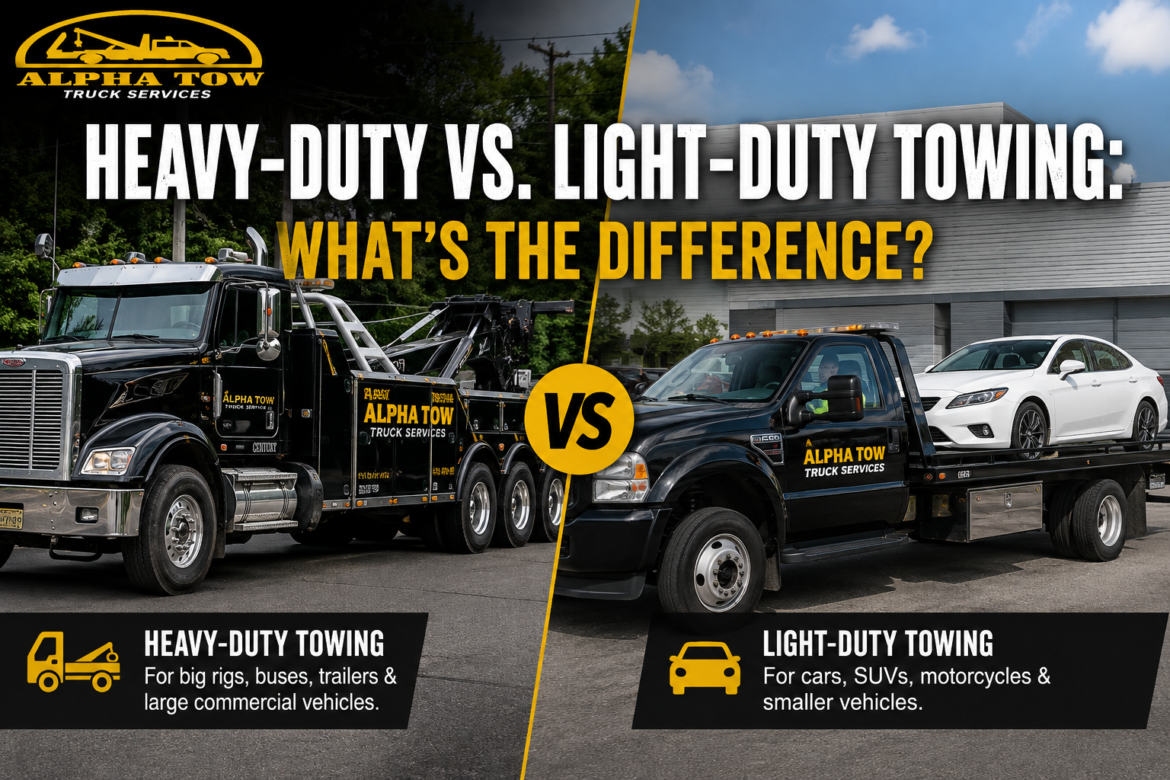
Light-duty towing handles standard passenger vehicles — cars, SUVs, minivans, and pickup trucks, generally under 10,000 pounds, using smaller, maneuverable tow trucks.
Heavy-duty towing handles commercial and oversized vehicles like semi-trucks, buses, RVs, and loaded box trucks, generally over 26,000 pounds, using large wreckers with far greater lifting power, stronger frames, and specialized recovery equipment. The dividing line comes down to your vehicle’s weight, not just its size.
What Is Light-Duty Towing?
Light-duty towing covers the vehicles most drivers own and interact with daily: sedans, hatchbacks, SUVs, minivans, motorcycles, and standard pickup trucks. These vehicles generally fall under a Gross Vehicle Weight Rating (GVWR) of roughly 10,000 pounds, placing them in truck classes 1 and 2.
Light-duty tow trucks are built for speed, maneuverability, and everyday response. They typically use flatbed platforms or wheel-lift systems, and a single trained operator can safely handle the job without needing a commercial driver’s license. This is the type of tow truck you’ll see responding to highway breakdowns, dead batteries, flat tires, and fender-benders across Dallas–Fort Worth.
Common light-duty towing situations:
- Sedan or SUV breakdown on the highway or in a parking lot
- Accident recovery for a standard passenger vehicle
- Flat tire with no usable spare
- Dead battery requiring transport to a shop
- Pickup trucks and minivans under roughly 10,000 lbs GVWR
What Is Heavy-Duty Towing?
Heavy-duty towing exists for vehicles that a standard tow truck simply cannot safely move. This includes semi-trucks, tractor-trailers, buses, RVs, garbage trucks, and other commercial vehicles typically weighing 26,000 pounds or more — classes 7 and 8 on the truck classification scale.
Heavy-duty tow trucks, often called wreckers, are built entirely differently from their light-duty counterparts. They’re equipped with high-capacity hydraulic booms — commonly rated around 25 tons — heavy-duty wheel lifts capable of handling several tons on their own, reinforced frames, air brake systems, and powerful winches for recovery situations like a jackknifed trailer or a vehicle that’s slid off the roadway.
Operating this equipment isn’t a routine skill. Heavy-duty towing typically requires a commercial driver’s license and specialized training, since the margin for error grows significantly when you’re recovering a fully loaded 40-foot trailer instead of a sedan.
Common heavy-duty towing situations:
- Semi-truck or tractor-trailer breakdown or accident
- Bus or RV recovery
- Loaded commercial box trucks or delivery vehicles
- Jackknifed trailers or vehicles requiring winch-out recovery
- Construction equipment or oversized load transport
Key Differences at a Glance
Weight capacity is the core distinction: light-duty trucks generally handle up to around 10,000 pounds, while heavy-duty trucks are built for 26,000 pounds and up — with medium-duty trucks bridging the gap in between for vehicles like box trucks and larger vans.
Equipment differs significantly as well. Light-duty trucks rely on flatbeds, wheel-lift systems, and standard hydraulics. Heavy-duty trucks use high-ton boom lifts, reinforced wheel lifts, air brake systems, and industrial-grade winches designed for recovery, not just transport.
Maneuverability favors light-duty trucks, which can navigate tight city streets, parking garages, and residential areas with ease. Heavy-duty trucks trade that agility for raw lifting power and stability, since their jobs typically happen on highways and open roads rather than tight urban spaces.
Licensing and training requirements are also different. Most light-duty tow operators don’t need a commercial driver’s license, while heavy-duty operators generally do, along with additional training specific to recovering large, loaded, or damaged commercial vehicles safely.
Cost reflects all of the above — heavy-duty towing typically costs more than light-duty towing, due to the specialized equipment, additional training, and complexity involved. That said, using a light-duty truck when a heavy-duty tow is actually required isn’t a way to save money; it usually leads to a failed attempt, wasted time, and potential damage to the vehicle.
Why Sending the Wrong Truck Is a Real Problem
It might seem like towing is towing, but mismatching the truck to the vehicle creates real risk. A light-duty truck attempting to lift a vehicle beyond its rated capacity can suffer equipment failure, and more importantly, can fail to properly secure a load it isn’t built for — creating a hazard on the road for everyone nearby.
On the other hand, dispatching a heavy-duty wrecker for a small passenger car isn’t dangerous, but it is inefficient and typically more expensive than necessary, since that size and equipment simply isn’t needed for the job.
This is exactly why a good towing company asks specific questions before dispatch — vehicle type, approximate weight, whether it’s loaded or empty, and the nature of the breakdown — rather than sending whichever truck happens to be closest.
How to Know Which Service You Need
- If you’re driving a standard car, SUV, minivan, or pickup truck — light-duty towing is almost always the right call
- If you’re driving or operating a semi-truck, bus, RV, or commercial vehicle over roughly 26,000 lbs — you need heavy-duty towing
- If your vehicle is loaded with heavy cargo, even a mid-sized commercial vehicle may require medium- or heavy-duty equipment
- If you’re unsure, tell the dispatcher your vehicle’s make, model, and whether it’s a personal or commercial vehicle — they’ll determine the right truck for you
FAQs: Heavy-Duty vs. Light-Duty Towing
Q. How do I know if I need heavy-duty or light-duty towing?
A. It comes down to your vehicle’s weight. Standard passenger vehicles under roughly 10,000 pounds need light-duty towing. Semi-trucks, buses, RVs, and loaded commercial vehicles over roughly 26,000 pounds need heavy-duty towing.
Q. Is heavy-duty towing more expensive than light-duty towing?
A. Generally, yes, due to the specialized equipment, additional operator training, and complexity of safely recovering larger vehicles.
Q. Can a light-duty tow truck tow a box truck or RV?
A. It depends on the specific vehicle’s weight. Smaller box trucks may fall into medium-duty range, while larger RVs and loaded box trucks typically require heavy-duty equipment. Always confirm your vehicle’s weight with the dispatcher.
Q. Do heavy-duty tow truck operators need special licensing?
A. Yes, in most cases. Operating heavy-duty recovery equipment typically requires a commercial driver’s license along with specialized training for handling large and loaded vehicles safely.
Q. What happens if the wrong type of tow truck is sent to my breakdown?
A. A truck that isn’t rated for your vehicle’s weight may be unable to safely lift or secure it, leading to delays, a second truck being dispatched, and in some cases, damage to your vehicle. Providing accurate vehicle details when you call helps avoid this entirely.
The Bottom Line
Heavy-duty and light-duty towing aren’t just different price tiers — they’re built around fundamentally different equipment, training, and vehicle weights. Knowing which one your situation calls for, and giving accurate details when you call, is what gets the right truck to you the first time.
Whether you’re stranded with a standard passenger vehicle or need a commercial truck safely recovered anywhere across Dallas–Fort Worth, Alpha Tow Truck Services dispatches the correctly equipped truck — light-duty or heavy-duty — based on your specific vehicle, so the job gets done safely and correctly the first time.